Sometimes the deeper meaning of a story doesn’t appear until we slow down and look at the language itself. Recently I found myself doing exactly that with the Genesis garden narrative—sitting with the Hebrew words, tracing their roots, and letting the letters speak in ways that English translations often hide.
What began as curiosity turned into something much richer. The story of Eden began to feel less like a rule about fruit and more like a meditation on the awakening of human consciousness.
Let’s walk into the garden together for a moment.
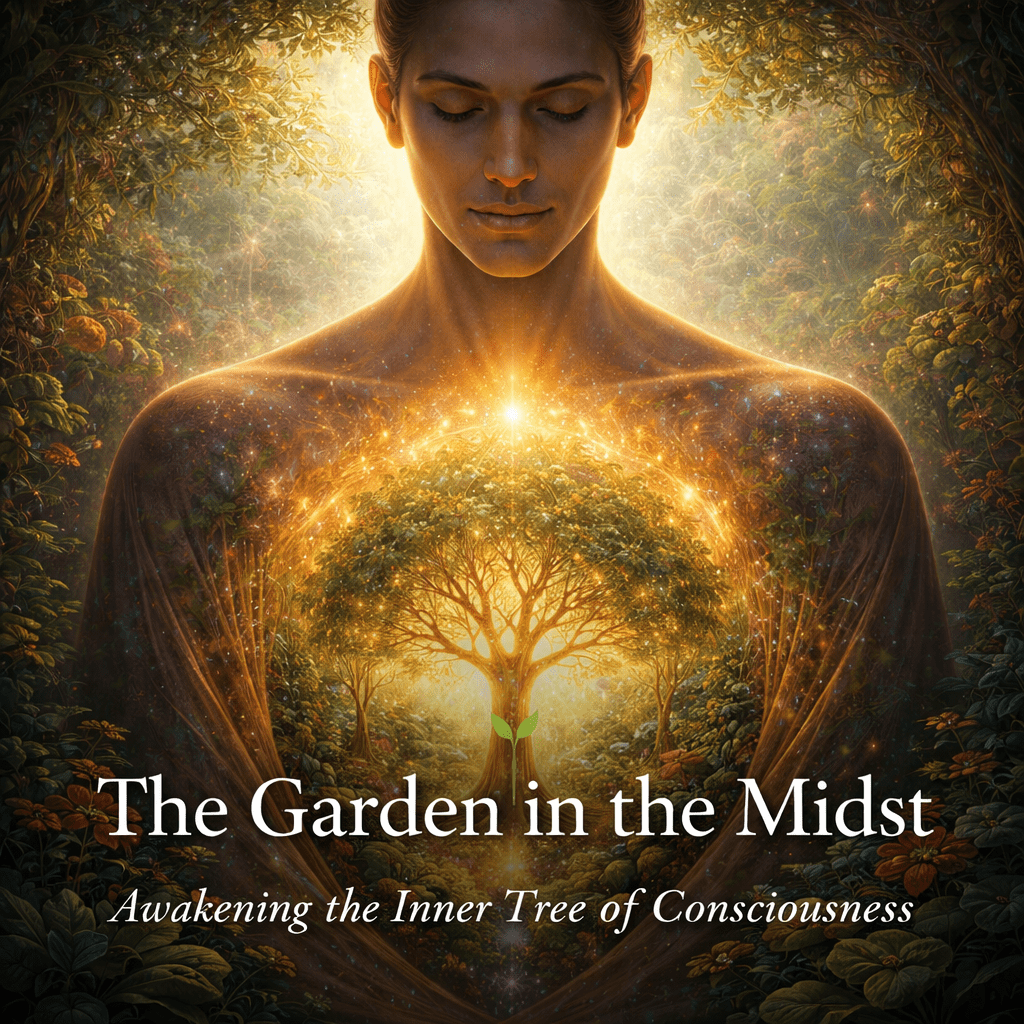
🌳 The Tree at the Center
In Genesis 2:9, the text says that two trees stood in the midst of the garden.
The Hebrew phrase is:
בְּתוֹךְ הַגָּן — betokh ha-gan
In the midst of the garden.
The word tokh means more than simply “middle.” It can also mean:
the inner part
the center
the heart of something
So the image being painted is not just geography. It’s symbolic placement. The tree stands at the center of the living enclosure.
And there are actually two trees mentioned there:
עֵץ הַחַיִּים (Etz ha-Chayyim) — the Tree of Life
עֵץ הַדַּעַת טוֹב וָרָע (Etz ha-Daʿat Tov va-Ra) — the Tree of the Knowledge of Good and Evil
But the narrative focuses on the second one.
🔎 The Phrase That Changes Everything
Let’s slow down and look closely at that phrase.
עֵץ הַדַּעַת טוֹב וָרָע
Etz ha-daʿat tov va-ra
Word by word:
עֵץ (etz) — tree
דַּעַת (daʿat) — knowledge, experiential awareness
טוֹב (tov) — good
רָע (ra) — bad or harmful
Ancient Hebrew often pairs opposites to describe the entire range of something.
For example:
heaven and earth → the whole cosmos
day and night → all time
So “good and evil” can function as a way of saying:
the full spectrum of discernment.
And the word daʿat doesn’t simply mean intellectual knowledge. It comes from a root that implies direct experience and awareness.
Suddenly the phrase begins to sound different.
It becomes something like:
the tree of experiential awareness across the whole range of life.
👁 The Letters Tell a Story
When we look at the older pictographic roots of Hebrew letters (often referenced through Paleo-Hebrew forms), the words themselves become almost like little visual stories.
Take the word עֵץ (etz) — tree.
Letters:
ע (Ayin) — originally pictured as an eye, symbolizing perception
צ (Tsade) — often depicted as a hook or a person lying in wait, associated with pursuit or seeking
Together, the letters can symbolically suggest something like:
what the eye perceives becomes the pursuit.
Perception begins the hunt.
And that is exactly what unfolds in the story.
🐍 The Subtle Wordplay
Right before the serpent appears, the text describes the humans like this:
Genesis 2:25
“They were both naked and were not ashamed.”
The Hebrew word for naked here is:
עֲרוּמִּים (arumim)
Then the very next verse says:
Genesis 3:1
“Now the serpent was more crafty…”
The word translated crafty is:
עָרוּם (arum)
These two words come from the same root.
Word Meaning
arumim naked / exposed
arum clever / perceptive
The story moves from innocent exposure to perceptive awareness.
And immediately after the encounter with the serpent, the text says:
“Their eyes were opened.”
The emphasis again is on seeing.
🌍 The Human from the Earth
Another layer appears in the word Adam.
In Hebrew we see this family of words:
אָדָם (adam) — human
אֲדָמָה (adamah) — soil or earth
דָּם (dam) — blood
Genesis says the human was formed from the dust of the ground.
The language almost rhymes:
Adam from Adamah.
The human is portrayed as living earth, animated by divine breath.
Earth becoming conscious.
🌿 The Moment Awareness Awakens
When the fruit is eaten, the text says:
“Their eyes were opened.”
And the first thing they notice?
Their nakedness.
Self-awareness appears.
Before this moment, the humans experience life without evaluation. Afterward, the mind begins categorizing reality:
good / bad
safe / dangerous
desirable / shameful
The garden has not changed.
But their perception of it has.
✨ The Threshold of Consciousness
The story suddenly reads like a description of a profound shift:
- Innocent awareness
- Questioning
- Pursuit of knowledge
- Eyes opening
- Self-consciousness
- Moral discernment
The birth of the reflective human mind.
And yet the narrative reminds us of something important.
Even with this new awareness, we are still adam from adamah—earth creatures breathing borrowed breath.
🌙 Living from the Inner Garden
So the question becomes:
How do we live wisely once awareness has awakened?
As I sit with this story, the invitation feels less about returning to innocence and more about learning to live from the secret center within us—that quiet inner garden where perception becomes wisdom rather than division.
Awareness gives us the power to categorize, judge, and divide. But it also gives us the ability to choose compassion, humility, and care.
In the Genesis story, the human was placed in the garden to tend and keep it.
Perhaps the deeper invitation remains the same.
To tend the garden of our own consciousness.
To cultivate perception that nourishes life rather than fractures it.
And to remember that even as awareness deepens, we are still earth and breath intertwined—living beings learning how to see.
🌿 A Gentle Invitation
If this story has been handed down through thousands of years, perhaps it is because it reflects something timeless about being human.
Awareness is both a gift and a responsibility.
So today I find myself asking quietly:
Where is the tree in the midst of my own life?
And how might I choose to see from that deeper place—the one where perception becomes wisdom, and the garden within begins to flourish again.
With devotion and wonder,
The Inspired Imaginative |The Devoted Mystic
© 2026 The Devoted Mystic.
All rights reserved. This content is the original work of the author and may not be copied or reproduced without explicit permission.


 thedevotedmystic.com
Leave a comment