There comes a moment in many inner journeys when a person begins to realize something unsettling:
Some of the thoughts, reactions, fears, compulsions, and bodily tensions they once assumed were “just who they are” may actually be inherited adaptations to the collective world around them.
Not chosen.
Conditioned.
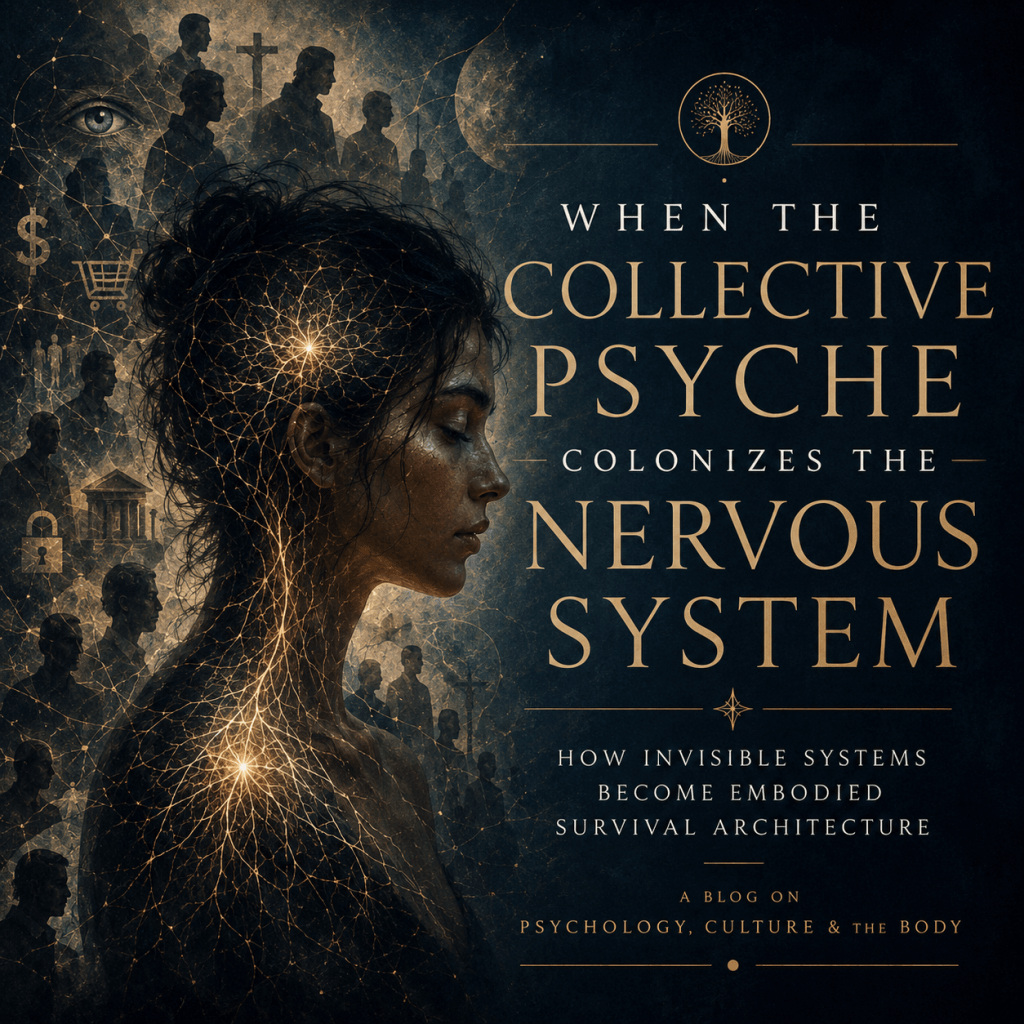
The psyche does not develop in isolation. From the moment we arrive here, we are shaped by systems already in motion — family structures, religions, economic pressures, social expectations, generational trauma, cultural ideals, gender roles, political climates, inherited fears, and unspoken rules about what is acceptable to feel, desire, embody, or become.
Over time, these forces do not merely remain conceptual.
They become physiological.
The nervous system begins organizing itself around collective expectations long before the conscious mind understands what is happening.
The body learns.
It learns what emotions are “safe.”
It learns when to stay small.
It learns how to anticipate rejection before rejection even arrives.
It learns how to perform belonging.
It learns how to survive symbolic exile.
And eventually, many people begin confusing adaptation for identity.
Hypervigilance becomes mistaken for responsibility.
Overworking becomes mistaken for virtue.
Self-abandonment becomes mistaken for love.
Emotional suppression becomes mistaken for maturity.
Exhaustion becomes mistaken for meaning.
Perpetual productivity becomes mistaken for safety.
The tragedy is not merely psychological.
It is embodied.
The jaw tightens around inherited expectations.
The breath shortens around invisible pressure.
The gut learns anxiety before language forms around it.
The muscles prepare for conflict that never fully arrives because the organism has become conditioned to anticipate danger as a permanent atmosphere.
The nervous system becomes occupied territory.
Not because there is something “wrong” with the individual, but because human beings are profoundly adaptive creatures. We internalize environments in order to survive them.
This is part of why genuine transformation can feel so destabilizing.
When an old collective script begins loosening its grip, the body often interprets that loosening as danger.
A person may consciously desire freedom while their nervous system panics at the loss of familiar conditioning.
Because familiarity is not the same thing as safety.
Many people discover that they do not actually know what they feel underneath performance, obligation, or inherited identity structures. They know how to respond. They know how to function. They know how to maintain coherence. But beneath that… there can be grief, rage, exhaustion, longing, creativity, tenderness, and unlived life waiting beneath decades of adaptation.
From a Jungian perspective, this is part of individuation.
Not self-improvement.
Not spiritual perfection.
Not transcendence through bypassing.
But differentiation.
The slow and often uncomfortable process of asking:
What is truly mine?
What belongs to my lineage?
What belongs to collective fear?
What belongs to survival?
What belongs to the persona I built to remain loved, useful, acceptable, or safe?
And perhaps most importantly:
Who might I become if my body no longer had to organize itself around constant psychological bracing?
This does not mean rejecting society, abandoning structure, or imagining oneself beyond the collective. Human beings are relational beings. We belong to one another. We are shaped by one another.
But there is a profound difference between participating consciously in a symbolic system and being unconsciously possessed by it.
The collective psyche becomes dangerous when its myths move through us unquestioned.
When productivity replaces humanity.
When ideology replaces direct experience.
When belonging requires self-erasure.
When certainty becomes more valued than aliveness.
When the nervous system is trained to obey fear more than truth.
Sometimes awakening is not becoming “more spiritual.”
Sometimes awakening is simply the realization:
“My body has been obeying stories I never consciously consented to.”
And that realization, while disorienting, may also become the beginning of freedom.
🔔 Invitation
Take a moment today to notice your body.
Not to fix it.
Not to optimize it.
Not to force healing.
Simply notice.
Where are you bracing?
What expectations live in your muscles?
What inherited myths still shape your breathing, your pacing, your worthiness, your exhaustion?
And gently ask yourself:
“What would soften if I no longer believed I had to earn my right to exist?”
With devotion and wonder,
The Inspired Imaginative | The Devoted Mystic
© 2026 The Devoted Mystic.
All rights reserved. This content is the original work of the author and may not be copied or reproduced without explicit permission.

 thedevotedmystic.com
Leave a comment