On false color, death, and the human need to see what cannot be seen 🌌🕯️
There is a moment—often in grief, often in wonder—when the mind stops categorizing and simply recognizes.
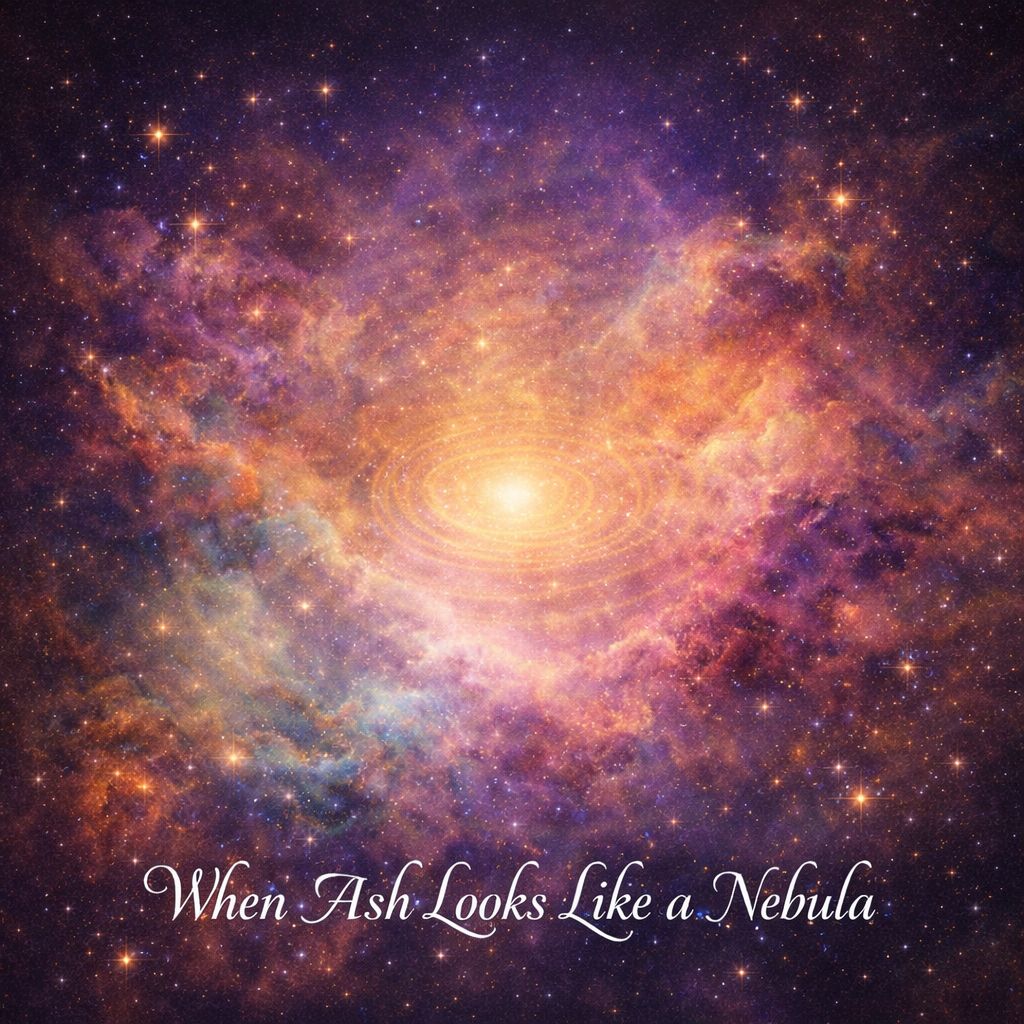
Someone notices that cremated remains under a microscope can resemble a nebula.
Someone else pauses over an image from deep space and feels an ache that has nothing to do with astronomy.
And the question arises, quietly, without spectacle:
Why does this feel familiar?
False color is not a lie
Astronomers use something called false color when imaging the cosmos. Not because space is deceptive—but because our eyes are limited.
Much of the universe does not emit light in the narrow band we call “visible.” Telescopes gather information from infrared, ultraviolet, radio waves, X-rays. Scientists then translate that data into color so the human mind can perceive structure: temperature, density, motion, chemistry.
Artists and microscopists do the same thing.
Bone ash under magnification is mostly calcium phosphate—fractured, porous, reshaped by extreme heat. Under polarized light or electron microscopy, color is added not for decoration, but for discernment. It reveals flow, fracture, clustering. Without it, the image is gray. With it, form appears.
False color is not deception.
It is a bridge.
It allows what cannot be directly seen to be held by consciousness.
The psyche recognizes pattern before meaning
This is where the conversation stops being technical and becomes human.
Because when people see these images—nebulae, ashes, cells, minerals—they don’t respond with data first. They respond with recognition.
Something in us knows these shapes.
Swirls. Voids. Filaments. Densities suspended in vastness.
And sometimes, recognition doesn’t arrive visually at all.
Sometimes it arrives as sound.
Since February 2025, a particular song—“A Message from the Stars”—has auto-played into my life again and again. Not once or twice, but with a persistence that feels less like coincidence and more like insistence. It arrives when I am not seeking it. It slips in between other songs, other moments, other thoughts.
I don’t chase meaning from it.
I let it land.
And every time, it carries the same quiet feeling: not instruction, not prediction—but orientation. As if something vast is not speaking to me, but reminding me where I am standing in relation to it.
Death is not framed as erasure in the deep psyche
Across cultures and centuries, the human psyche has used symbolic images to approach what cannot be grasped directly: death, transformation, origin, return. Mandalas, spirals, smoke, stars, dust.
In most ancestral and mythic traditions, death is not understood as annihilation. It is understood as redistribution.
Ash to earth.
Earth to field.
Field to air.
Air to star-matter.
When ashes resemble nebulae, the psyche does not interpret this as metaphor. It interprets it as continuity without identity.
Not “this person still exists as they were,”
but
“this being has rejoined the pattern-field.”
That is the same feeling that song carries when it returns—not comfort in the sentimental sense, but reassurance without promise. A knowing that nothing essential has been lost, only re-patterned.
Color as consciousness
In symbolic language, color represents awareness.
Black and gray are the undifferentiated unknown—the place before form. Color marks emergence, articulation, relationship. When we add color to ash or cosmos, we are doing what the psyche always does:
We are saying, I am ready to see this.
Sound does something similar.
It bypasses analysis and goes straight to the body.
It reminds us that we are not observers of the universe—we are resonant within it.
False color and recurring melody are kin.
Both are translations.
Both allow contact without collapse.
Why this matters now
In a culture that has largely lost shared death rituals, people reach instinctively for cosmic imagery. Space becomes the new mythic language. Nebulae become modern mandalas. Stars take the place once held by angels.
And music—especially the kind that seems to find us—becomes a kind of informal liturgy. A repetition that doesn’t explain, but steadies.
When a song called “A Message from the Stars” keeps arriving unbidden, it doesn’t feel like spectacle. It feels like companionship. Like something vast saying: you are not misplaced in this moment of unknowing.
A quiet truth
We do not return to nothing.
We return to structure without name.
And sometimes, the only way to sense that
is through color,
or sound,
or a pattern that keeps repeating until we finally stop brushing past it.
Not to change reality—
but to meet it.
🔔 Invitation
If something has been repeating in your life—a song, an image, a phrase, a symbol—pause before dismissing it. Ask not what it means, but what it is helping you remember. Some messages are not meant to be decoded. They are meant to be felt.
With devotion and wonder,
The Inspired Imaginative | The Devoted Mystic
© 2026 The Devoted Mystic.
All rights reserved. This content is the original work of the author and may not be copied or reproduced without explicit permission.

 thedevotedmystic.com
Leave a comment