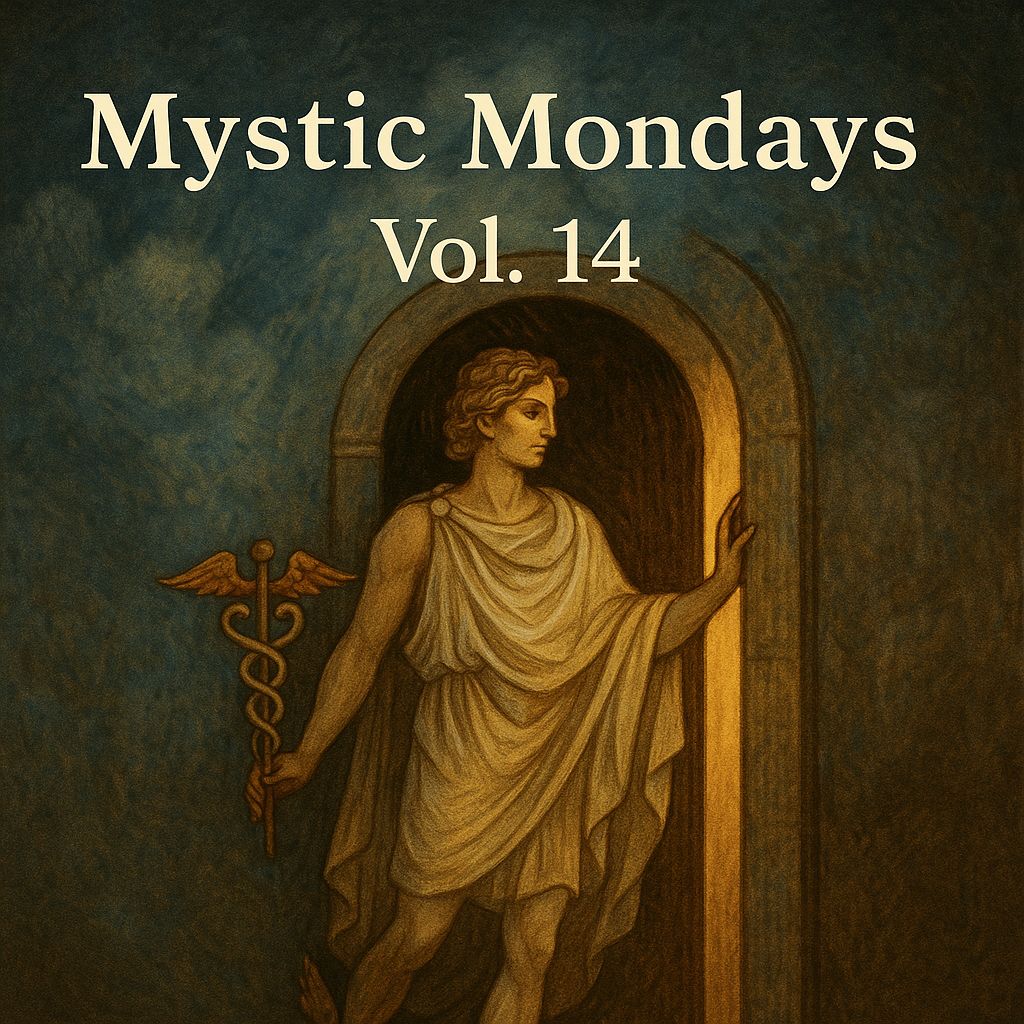
Mystic Mondays · Vol. 14
In every age, there are moments when a figure from myth seems to lean a little closer — not as a deity demanding devotion, but as an archetype revealing itself at precisely the right crossroads. Hermes is one of those figures. He doesn’t arrive with thunder or spectacle. He arrives in motion, in whispers, in the small tilt of the world where one thing ends and another quietly begins. ✨
Hermes is the ancient god of thresholds, messengers, and movement, but he is also the inner force that refuses to let us stay stagnant. His statues — the herms placed at boundaries and roadways — were not images to be worshipped, but markers that said: pay attention here. Something is shifting. Something is crossing. Something is speaking. 👣
To encounter Hermes is to encounter transitions in their purest form.
He is the one who carries us from the known into the unknown, who bridges the mind and the soul, who holds the door open just long enough for us to step through. In his myths, he moves between worlds with ease — Olympus, Earth, Underworld — not because he belongs to none of them, but because he belongs to all of them. Hermes reminds us that identity can be fluid, direction can be dynamic, and truth often arrives in motion rather than stillness. 🌬️
But Hermes is also the keeper of subtle messages — the kind disguised as intuition, synchronicity, or an unexpected symbol.
In ancient Greece, his presence was often recognized through the smallest details: a winged sandal, a caduceus, the posture of a traveler mid-step. Today, he appears in equally liminal ways: a dream that feels like guidance, a sudden insight at a crossroads moment, an image or statue that seems to pulse with meaning the moment you see it. 🕊️
Hermes is the moment of recognition.
He is the spark that says:
“This threshold matters. Slow down. Something speaks here.”
Because Hermes isn’t merely the god of thresholds — he is the threshold embodied. His myths teach that the point of crossing is itself a sacred event. To invoke Hermes is not to welcome chaos, but to welcome movement with intention, clarity in transition, and a wiser relationship with change. 🔱
In a world that often glorifies certainty, Hermes restores the sacredness of curiosity, intuition, and the in-between. He teaches that messages are not always delivered in linear language; sometimes they are felt in the body, seen in a symbol, or recognized only after we’ve stepped forward.
Hermes does not ask for allegiance — he asks for awareness.
He does not demand devotion — he asks for discernment.
And he does not arrive to lead us away from ourselves — he arrives to lead us toward what is ready to awaken. ✨
As we continue this mythic journey, Hermes stands at the familiar doorway: one hand resting on the frame, a knowing half-smile, wings poised. Not to force a path, but to illuminate one. Not to impose answers, but to remind us that the messenger is also the message.
Crossroads are sacred not because they offer a single route forward, but because they show just how many paths are possible.
And Hermes — ever the guide, ever the wanderer — walks with us as we choose. 🚪✨
🌕 Closing Thoughts
Some thresholds arrive softly, almost shy, asking only that we notice the shift. Others shimmer with unmistakable clarity, carrying the unmistakable breath of the Messenger himself. This week, may you feel the subtle tug toward movement — the gentle nudge toward your next right step — and trust the intelligence woven into every crossing. Hermes teaches that momentum is sacred, and that listening is an art. May the crossroads speak, and may you hear what’s meant for you.
With myth and wonder,
The Inspired Imaginative |The Devoted Mystic
© 2025 The Devoted Mystic.
All rights reserved. This content is the original work of the author and may not be copied or reproduced without explicit permission.


 thedevotedmystic.com
Leave a reply to In Between Cancel reply