Paracelsus: The Alchemist Who Dared
“He who does not know anything must believe everything.” — Paracelsus
There are souls who arrive not to kneel before knowledge but to ignite it.
Paracelsus walked among such embers — a man too fierce for the universities that scorned him, too mystical for the physicians who feared him, and too curious for the priests who demanded silence.
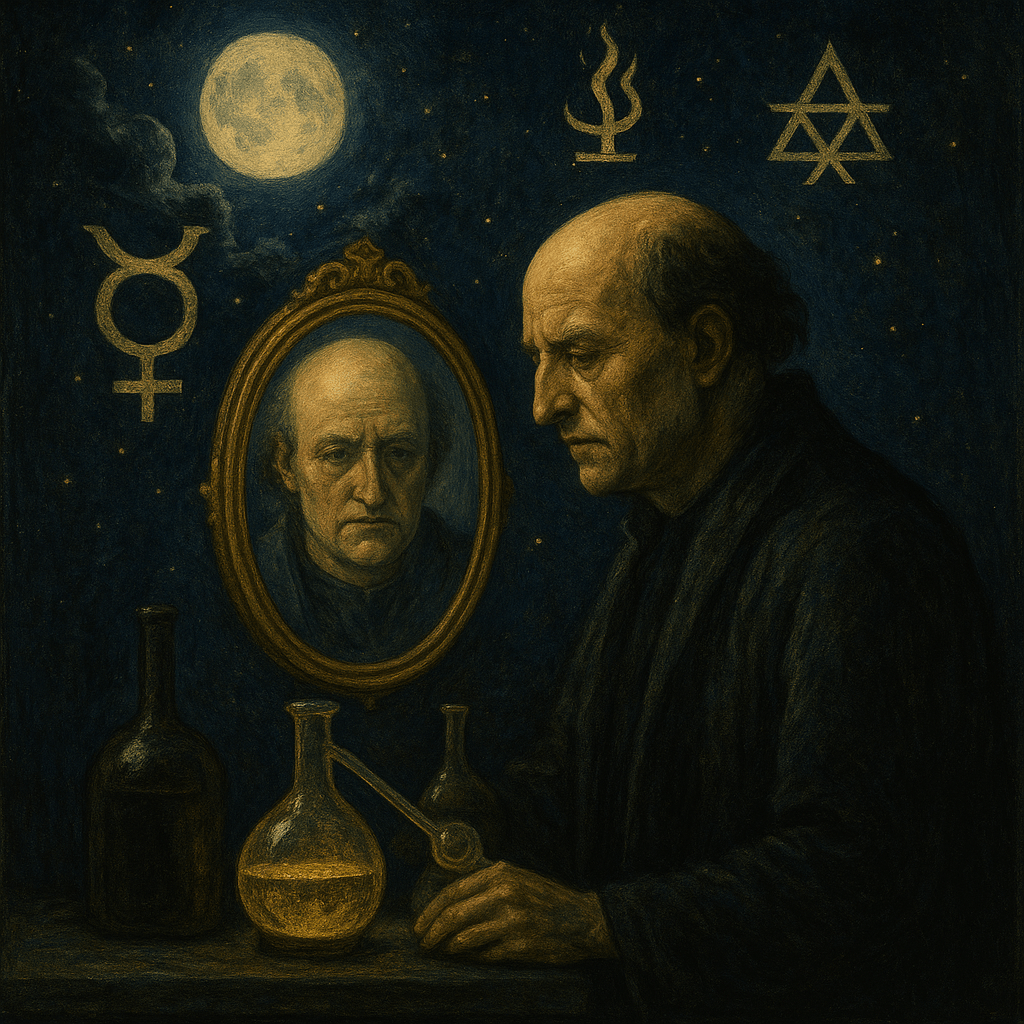
Born Theophrastus Bombastus von Hohenheim (1493–1541), his very name was an invocation of contradiction — bombastic, divine, heretical, prophetic.
He believed that to heal the body one must first read the soul, that all medicine was a language written by God in the flesh of Earth itself.
To Paracelsus, the body was not a cage for spirit but a laboratory of revelation.
Each sickness, a cipher.
Each organ, a sacrament.
Each element, an alphabet of the Divine.
⚗️ The Mystic Physician
He refused the sterile comfort of the lecture hall and walked among the sick and poor, gathering remedies whispered by forest women and heretical monks.
Where others saw superstition, he saw living scripture — the anima mundi speaking through mineral and moss.
In the crucible of his vision, alchemy was not the pursuit of gold, but the purification of perception.
Sulphur, mercury, and salt were not ingredients; they were metaphors — fire, spirit, and body — the trinity of transformation that governs every human life.
His medicine did not end at the wound; it began there.
Because beneath every ailment, he believed, was a soul asking to be remembered.
🜂 The Rebel Alchemist
He was the first to ever lecture in the language of the street, rather than in the official academician’s Latin, and the first to publicly condemn the medical authority of Avicenna and Galen, flinging their writings into a bonfire on St. John’s day in 1527.
Declaring that no written word — not Galen’s, not Avicenna’s — could outweigh direct communion with Nature’s truth.
He was branded dangerous, a blasphemer who claimed that the stars and elements were divine intermediaries.
But Paracelsus did not fear the Church, nor the academy.
He feared only the disease of forgetfulness — the moment humankind divorced spirit from matter and called it progress.
He stood at the precipice of a world shifting toward rationalism and whispered,
“You are more than dust. You are the medicine you seek.”
Even Jung, centuries later, felt his shadow at the edge of the unconscious — that same conviction that the psyche itself is an alchemical furnace, and every darkness conceals a tincture of light.
🌙 The Mirror Within
Paracelsus teaches us that rebellion is a sacred function of the healer’s path.
To challenge orthodoxy — internal or external — is to re-enter the living covenant between heaven and earth.
When your own life feels like a burning laboratory, when your truths are misunderstood by the world, remember:
Transformation rarely wears the approval of its age.
The elixir is found only by those willing to risk contamination.
So, beloved seeker, the next time your spirit trembles between faith and defiance, imagine Paracelsus walking beside you — vial in hand, heart aflame — reminding you that the Great Work was never meant to be clean.
It was meant to be true.
🔔 Invitation
Close your eyes.
See the laboratory not as a place of beakers and smoke, but as your own sacred anatomy — lungs breathing the memory of stars, bones remembering the salt of ancient seas.
Whisper his creed to yourself:
“I am the medicine. I am the fire. I am the philosopher’s stone becoming.”
Then ask:
What outdated formula still dictates your healing?
What heresy must you dare to speak to become whole?
With devotion and wonder,
The Inspired Imaginative | The Devoted Mystic
© 2025 The Devoted Mystic.
All rights reserved. This content is the original work of the author and may not be copied or reproduced without explicit permission.

 thedevotedmystic.com
Leave a comment