🔮 Historical Mirrors, Vol. VI: Abd al-Qādir al-Jazāʾirī (1808–1883)
“The true warrior is not the one who fights the most, but the one who transforms the battle into a path of divine return.”

🜃 The Man Between Worlds
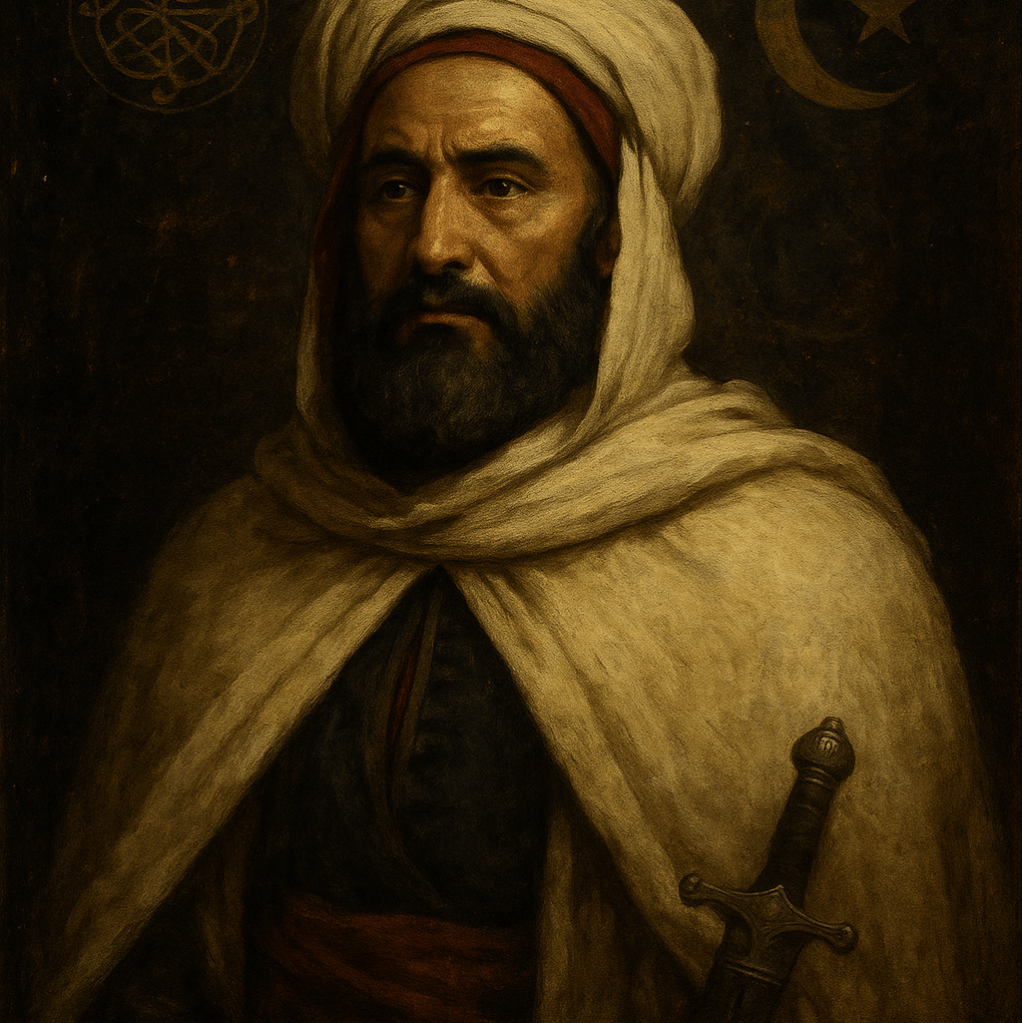
Born into a lineage of Sufi scholars in the mountains of Algeria, Abd al-Qādir al-Jazāʾirī was raised at the sacred seam between mysticism and militancy. By the age of 25, he was leading a guerrilla resistance against French colonizers who sought to dismantle his homeland — but this was no ordinary commander.
He prayed in secret caves, fasted for weeks, and studied Ibn Arabi while training horsemen in desert strategy. His sword was sharp, but so was his soul — he was equally at home in a Qur’anic commentary as he was on the battlefield.
And when the French finally overpowered him, they expected vengeance. Instead, he shocked the world by offering protection to Christian monks, advocating peaceful resistance, and composing spiritual treatises while imprisoned in France.
🜁 Sacred Paradox: The Sufi and the Sword
What makes Abd al-Qādir a mirror worth gazing into isn’t merely his military genius. It is the way he held paradox like a lantern in the dark.
He was:
- A warrior who practiced radical mercy.
- A political leader who bowed to mystical truths.
- A prisoner who became freer in exile than most sovereign kings.
- A Muslim holy man who protected Christian lives during civil war.
He lived his spiritual path not in retreat, but in resistance. He prayed with calloused hands and a broken heart, holding the line between earth and heaven with grit and grace.
🜂 Jungian Archetypal Reflection: The Mystic Warrior as Sacred Integration
Abd al-Qādir al-Jazāʾirī emerges not as a fragmented figure of history, but as an integrated archetype — a living mandorla between opposing forces. In Jungian terms, he embodies the Self in its rarest form: a unifier of shadow and spirit, of animus and divine law, of sacred masculine force expressed through spiritual consciousness.
Where others split between the Warrior and the Sage, he forged them into one. His resistance was not egoic conquest, but soul-led defense — an act of alignment with something greater than personal survival.
He is a mirror of:
- The Warrior, not in toxic domination, but in the highest form of sacred protection. The sword not as weapon, but as boundary for the sacred.
- The Sage, not retreating into solitude, but descending into the political and the violent with the light of gnosis still burning.
- The Self, individuated through paradox, tested through exile, and forged in the fire of humility.
In his later life — especially in exile — we glimpse a further transformation: from archetypal warrior to wounded healer. In France, stripped of status but revered for his inner clarity, he became a silent bridge between empires, faiths, and human hearts.
🌒 A Mirror for Now
In a time when religion is often hijacked by extremism and mysticism is dismissed as passive, Abd al-Qādir offers a fierce third way:
🜃 A mysticism that acts.
🜃 A leadership that listens.
🜃 A faith that liberates — not dominates.
He reminds us that sacredness doesn’t require silence.
And that resistance, when rooted in love, can become holy.
🕯️ Inner Mirror Prompts
- What opposites within me long to be reconciled into sacred leadership?
- How do I hold paradox without defaulting to either fight or flight?
- What would it mean to lead — not by dominance — but by mystical alignment?
- Can I walk through exile and still radiate sovereignty?
✍️ Altar Offering
Create a small altar space with:
- A desert stone (or salt) for endurance
- A white cloth for surrender
- A quote or phrase that reminds you:
“I serve not to win, but to sanctify.”
Speak aloud:
“I walk with both sword and silence,
I kneel only before the Divine,
I lead with soul — not ego.
May I remember that resistance is sacred when rooted in Love.”
🜃 Closing Thoughts
Abd al-Qādir al-Jazāʾirī stands not merely as a figure from the past, but as a threshold presence — a reminder that true leadership does not require the abandonment of spirit, and that resistance, when rooted in sacred alignment, becomes a form of prayer.
In a world where many fracture under the weight of contradiction, his legacy invites us to integrate the paradox — to wield the sword of truth and the lantern of mercy, both.
He is a mirror for the mystic who is also a warrior.
A whisper to the rebel whose rebellion is rooted in love.
A path for the soul who resists erasure by remembering what is holy.
May we not forget:
The strongest fortresses are often built of silence,
And the fiercest warriors sometimes kneel to listen.
Until Next Time,
The Inspired Imaginative | The Devoted Mystic
© 2025 The Devoted Mystic.
All rights reserved. This content is the original work of the author and may not be copied or reproduced without explicit permission.


 thedevotedmystic.com
Leave a comment