In Jungian terms, Billy the Kid isn’t merely a historical figure. He’s an American mythic complex—a living embodiment of archetypal forces that many of us carry within.

🧠 The Orphan Child – The Wounded Innocent
Billy begins as the Orphan, not just literally but psychically.
Jung viewed the Orphan archetype as the one who carries the wound of abandonment—betrayed by the “parental” figures of society, left to navigate an indifferent world. The Orphan learns early that the world is not safe. Yet, paradoxically, this pain sharpens the gift of perception. Billy’s quick wit, literacy, and adaptability were survival mechanisms, but they were also soul gifts.
The Orphan becomes wise before their time. But without love, the wisdom turns into wariness.
Billy did not become dangerous until justice proved itself to be a lie.
This is the turning point in many orphan myths—when the child realizes the system that abandoned them is also rigged against them.

🗡️ The Rebel / Outlaw – Sacred Defiance
As the Orphan matures, he often evolves into the Rebel or Outlaw. This is the part of the psyche that will no longer accept injustice. In Jungian thought, the Outlaw isn’t evil—it is the part of the Self that refuses to betray its own moral compass even when society punishes it for doing so.
Billy’s war wasn’t lawlessness for the sake of chaos—it was a cry for sacred fairness in a lawless land where “justice” was for sale. The Rebel in him said: If justice won’t protect the innocent, I will.
He becomes a vessel for Sacred Rage, a martyr of integrity rather than malice.
🌓 The Shadow – Projection and Demonization
Billy the Kid became a national Shadow. What Jung called the disowned self—the part of the collective that society refuses to integrate—is often projected onto a scapegoat. Billy was demonized not because of what he truly was, but because of what the American psyche refused to confront:
- The violence at the core of its expansion
- The systemic betrayal of the vulnerable
- The myth of “law and order” in a lawless conquest
To tame the chaos, the culture painted Billy as the source of it, rather than the symptom of it. He carried the shadow of a nation that refused to face its own outlaw origins.
🔥 The Trickster – Cleverness and Anima Energy
Billy also carried the energy of the Trickster, a liminal archetype who breaks rules not just for survival but transformation. He escaped jails, charmed enemies, and moved between cultures. He wasn’t just a warrior—he was witty, quicksilver, almost Mercurial.
The Trickster often holds a strong connection to the Anima, the inner feminine or emotional self that brings balance. Billy’s closeness with Mexican families, his dancing, his fluency in Spanish, his emotional loyalty to his companions—these are signs of a soulful man not yet severed from his softness.
This is not common in stories of the outlaw. But it is crucial.
🕊️ The Sacrificed Youth – A Myth Repeated
Billy’s death at 21 echoes an archetype as old as myth itself: the Sacrificed Youth. Like Osiris, like Christ, like Arthur, Billy dies before his time—betrayed by someone once trusted.
In Jungian mythology, these figures don’t die because they’re failures.
They die because the world isn’t ready to receive the wholeness they represent.
Billy represented an unassimilated truth: that the soul cannot thrive in a system built on betrayal, greed, and illusion. His death wasn’t justice. It was a ritual scapegoating of the part of the collective Self that cried out for authenticity.
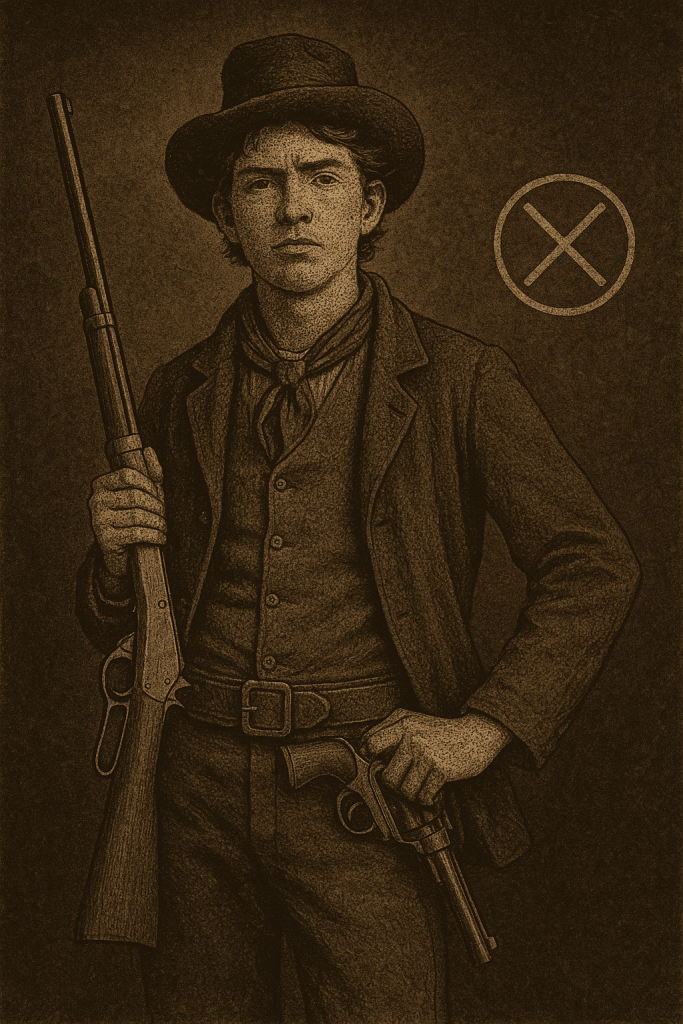
🪶 Final Reflection: Billy as Inner Ally
We all carry the Kid within us:
- The child who was left to fend for themselves.
- The rebel who says “no more” when lines are crossed.
- The misunderstood one who speaks truth in a language the world refuses to hear.
- The one who dies inside when betrayal replaces belonging.
In dreamwork and soulcraft, Billy might appear as a dust-covered guide, showing us the price of betraying our inner truth—and the holy fire that burns when we refuse to.
🕯️
So, I invite you now—not to remember Billy the Kid as the gun-smoke ghost the world insists he was,
but to meet him again, behind the veil.
To see the Orphan. The Rebel. The Trickster. The boy who mourned justice and still danced.
Let him sit beside the exiled parts of you.

Let him walk with you into your own outlawed memory…
🕯️ An Invitation to the Outlawed Parts of Yourself
Come now,
you ragged flame,
you were told to smother.
Come, ash-covered wildness,
they made you shame.
You who flinched at justice twisted,
You who ran because no one stayed.
You who spoke too soon,
or not at all.
I see the hunger in your bones—
not for vengeance,
but for being seen.
This is not a summons to behave.
This is not a prayer for polish.
This is the cracked-hand, dirt-hearted kind of welcome
that makes even the exiled believe they were holy all along.
So sit.
Unholster your silence.
Lay your legend down beside mine.
The fire won’t ask you to confess.
It only asks you to remember
what they outlawed
was often
what was most alive.
Thank you for wandering these shadowlands with me.
For refusing to look away from the myth beneath the myth.
For honoring the lost souls who never asked to be legend.
Until next time—
Stay wild, stay woven, stay awake.
With sacred defiance and mythos in my marrow,
The Inspired Imaginative | The Devoted Mystic
© 2025 The Devoted Mystic.
All rights reserved. This content is the original work of the author and may not be copied or reproduced without explicit permission.


 thedevotedmystic.com
Leave a comment