From the Egyptian Heart to the Hebrew Lev
🤍
Throughout history, cultures separated by deserts, seas, and centuries described something remarkably similar: the inner landscape of a human being. Long before psychology existed as a formal discipline, ancient civilizations were already mapping the soul.
Not through laboratories or brain scans, but through symbols, myths, and sacred texts.
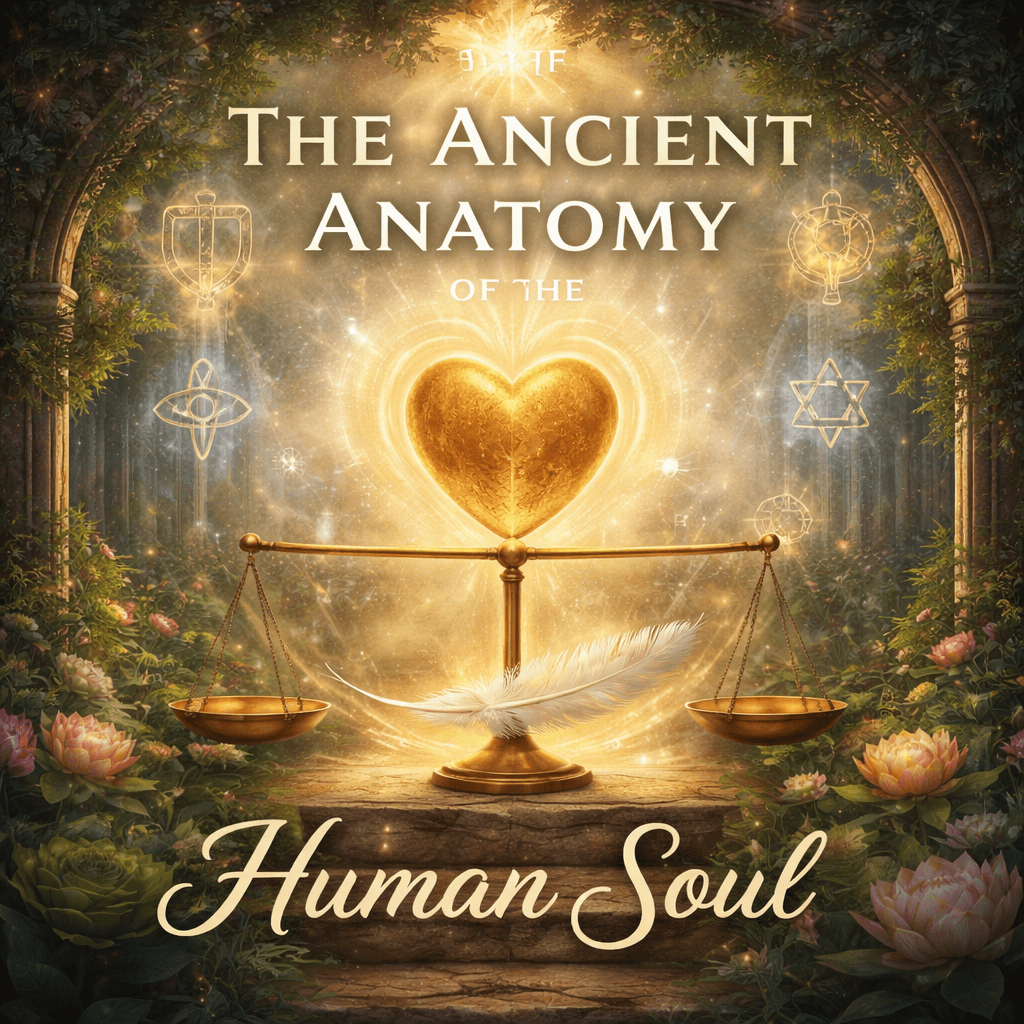
When we place Egyptian, Hebrew, Greek, and other traditions side by side, a quiet pattern begins to emerge. Each describes the human person as possessing an interior center—something deeper than intellect alone. A place where intention, conscience, memory, and awareness converge.
Different languages named it differently, yet the meaning feels strangely familiar.
The Egyptian Heart: The Record of a Life
In ancient Egypt, the heart was believed to contain the memory of one’s life. When a person died, their heart was weighed against the feather of Ma’at—symbol of truth, balance, and cosmic order.
The scene appears in the Book of the Dead, where the god Anubis carefully balances the scales while Osiris presides over the judgment.
The deceased then speaks what scholars call the Negative Confession, a series of declarations such as:
- I have not lied.
- I have not caused suffering.
- I have not stolen.
- I have not polluted the waters.
These statements were not simply moral rules. They were affirmations of alignment with Ma’at, the deeper order of the cosmos.
In Egyptian thought, the heart could become heavy with distortion—violence, greed, deceit. But when a life was lived in harmony with truth, the heart remained light enough to balance the feather.
It is a poetic way of saying something deeply psychological: our actions shape the interior weight of our being.
The Hebrew Heart: The Inner Center of Awareness
Hebrew tradition also places remarkable emphasis on the heart.
The Hebrew word לב (lev) does not merely refer to emotion. It includes thought, intention, moral reasoning, and desire—the core of the inner person.
One of the most intriguing statements about the heart appears in Jeremiah:
“The heart is crooked above all things and deeply wounded—who can truly know it?”
At first glance this seems pessimistic. Yet the verse is less about condemning the human heart than about acknowledging something profound: the human mind is capable of self-deception.
Immediately afterward, the text continues:
“I search the heart and examine the inner being.”
The emphasis here is not punishment, but truth revealing what lies beneath the surface.
Just as the Egyptian heart is weighed against the feather of Ma’at, the Hebrew heart is searched and examined for alignment with truth.
Greek Thought: The Psyche
In Greek philosophy another word appears: psyche.
While modern English uses the word “psyche” to mean mind or personality, the Greeks understood it as the life-breath or animating essence of a person.
Philosophers like Socrates and Plato spoke of caring for the soul as the highest human responsibility.
To “know thyself,” inscribed at the temple of Delphi, was not simply intellectual curiosity—it was an invitation to examine the deeper self.
Once again we encounter the same pattern: a civilization recognizing that human beings possess an inner dimension that must be brought into harmony with truth.
A Shared Insight Across Civilizations
When we step back from the individual traditions, something fascinating appears.
Across cultures we find similar concepts describing alignment with a deeper order:
Egypt spoke of Ma’at (cosmic harmony).
Hebrew tradition spoke of Tzedek and Mishpat (justice and righteousness).
Greece spoke of Dike (moral balance).
India spoke of Dharma (right order).
China spoke of the Dao (the Way).
Different languages, different myths—but the same underlying intuition.
🌒 Human beings flourish when their lives align with truth.
The Moment of Self-Recognition
The ancient Egyptian weighing of the heart may be one of the most vivid symbolic portrayals of this insight.
It imagines a moment when the soul stands before reality without illusion.
The scale simply asks:
Is the heart light with truth,
or heavy with distortion?
The Hebrew prophets asked a similar question when they spoke of the heart being searched and refined. Greek philosophers asked it when they urged students to examine their lives.
Across centuries, the question remains the same.
🌿 What is the condition of the inner self?
A Map of the Human Interior
These ancient traditions were not merely creating religious rules. They were sketching an early anatomy of the soul.
They recognized that within each human being there exists:
- a center of awareness
- a capacity for truth
- a tendency toward self-deception
- and a longing to live in harmony with something larger than the self.
Modern psychology would later rediscover many of these ideas in its own language.
But the ancients had already drawn the map.
They simply used feathers, scales, prophets, and philosophers to do it.
🔔 Invitation
Beloved seeker, may this reflection serve as a quiet mirror for the interior life.
Across cultures and centuries, wisdom traditions seem to whisper the same gentle truth: the most meaningful journey is not outward but inward. Not toward perfection, but toward alignment.
May your heart grow lighter with every step you take toward truth.
With devotion and wonder,
The Inspired Imaginative | The Devoted Mystic
© 2026 The Devoted Mystic.
All rights reserved. This content is the original work of the author and may not be copied or reproduced without explicit permission.

 thedevotedmystic.com
Leave a comment