There are moments when the body teaches something the mind hasn’t yet studied.
This was one of those moments.
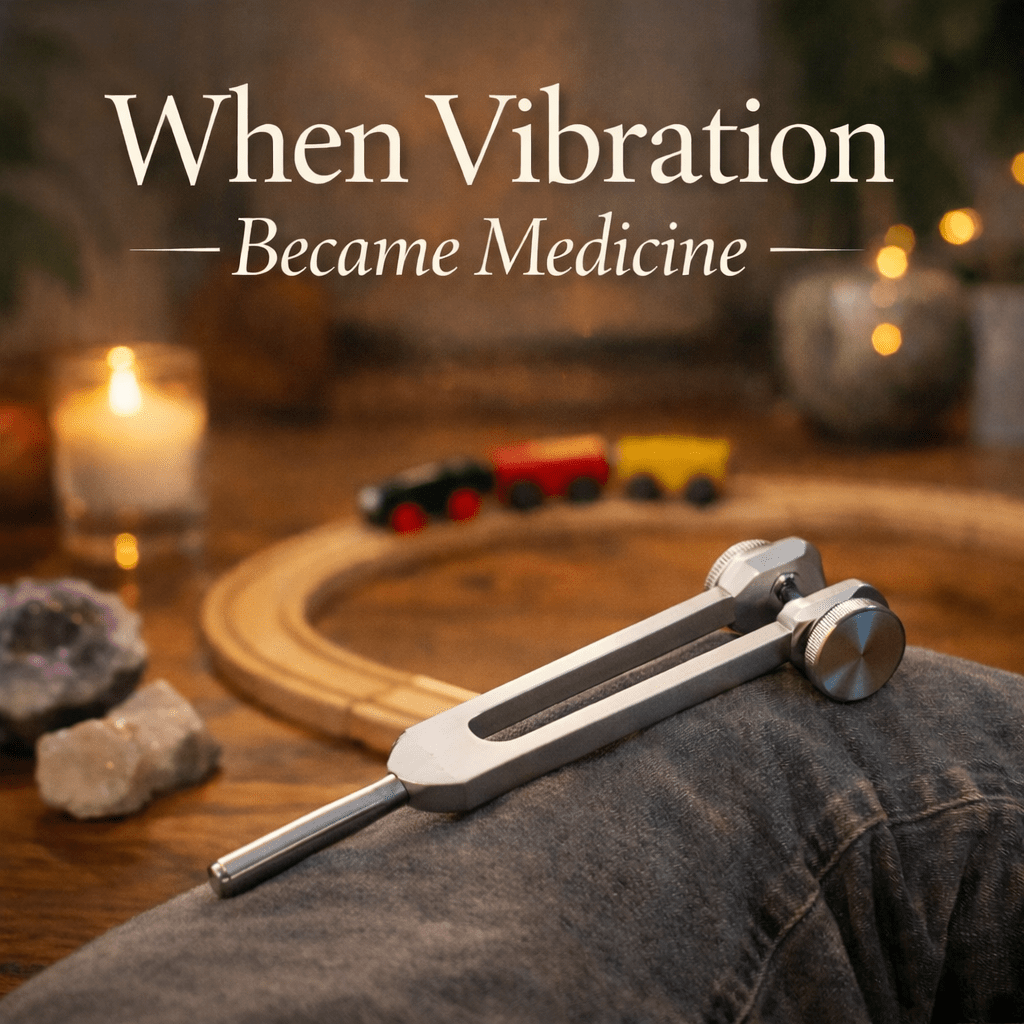
I had been on the floor playing train tracks with my three-year-old grandson — knees bent, legs tucked, fully immersed in the sacred architecture of toddler engineering. By the time I stood up, my legs were aching in that familiar heavy, vein-sore way that sometimes follows long periods of compression or sitting low.
Not alarming.
Just uncomfortable.
I had already removed my thick socks and shoes, letting my feet cool and circulation reset. But the ache lingered — a dull pressure around my knees and along the areas where I tend to feel venous sensitivity.
Then came the quiet inner nudge.
Use the tuning fork.
I picked up my 128 Hz weighted tuning fork, activated it, and gently ran it across my knees. I paused and held it along the areas where the ache felt most concentrated. Within seconds — not minutes — the sensation shifted.
The pain didn’t slowly fade.
It simply… released.
My legs went from heavy and sore to light and neutral almost immediately.
Not dramatic.
Not mystical.
Just noticeably different.
And that simple experience sent me down a fascinating rabbit trail into the science of vibration and the body.
The Physiology Behind What Happened
While tuning forks are often discussed in holistic or energetic spaces, there is legitimate physiological science behind how localized vibration affects the nervous system and circulation.
Here’s what I discovered.
🧠 1. Vibration Can Interrupt Pain Signals
Pain and vibration travel along similar neural pathways in the body. According to the well-established Gate Control Theory of Pain, non-painful sensory input (like vibration or rubbing an area) can override or dampen pain signals before they reach the brain.
This is the same principle behind:
- rubbing a bumped elbow
- TENS units used in physical therapy
- vibration therapy tools
Low-frequency vibration — like that produced by a 128 Hz weighted tuning fork — stimulates large sensory nerve fibers that can temporarily “close the gate” on pain signals. When that happens, discomfort can reduce very quickly.
🩸 2. Vibration Supports Circulation and Venous Return
Research on localized vibration therapy shows it can:
- increase local blood flow
- stimulate venous and lymphatic movement
- reduce feelings of heaviness in the limbs
- relax muscle and connective tissue tension
After sitting on the floor with bent knees and compressed veins, it makes sense that circulation in my legs had slowed. The gentle vibration likely helped restore movement in those tissues, which is why the relief felt so immediate.
🌿 3. Fascia Responds to Gentle Vibration
Fascia — the connective tissue that surrounds muscles, joints, and vessels — is rich with sensory receptors that respond to pressure, stretch, and vibration.
Low-frequency vibration can signal fascia to soften and release. When fascia relaxes, pressure on nearby nerves and vessels decreases, often bringing that “lighter” feeling that follows a good stretch or massage.
What This Experience Taught Me
This wasn’t about finding a miracle tool.
It was about noticing how quickly the body can respond when given the right kind of support.
The sequence was simple:
- discomfort
- attunement
- gentle intervention
- relief
It reminded me that the body is not a problem to solve, but a system to listen to.
And sometimes, the most effective support isn’t dramatic or complicated — it’s responsive and intuitive.
The tuning fork didn’t “heal” anything.
It simply supported circulation, nerve signaling, and tissue relaxation in that moment.
And the body did the rest.
⚕️ A Gentle Medical Disclaimer
This reflection shares a personal experience and general scientific information about vibration and the nervous system. It is not medical advice and should not replace consultation with a qualified healthcare professional.
Persistent leg pain, swelling in one leg, redness, unusual warmth, or shortness of breath should always be evaluated by a medical professional, as those symptoms can indicate more serious conditions.
What I experienced was temporary, positional discomfort that resolved quickly with gentle self-care and movement. Every body is different, and what works for one person may not be appropriate for another.
🌙 An Invitation to Notice
Sometimes the body doesn’t need fixing.
It needs listening.
If you have tools that support your nervous system — breath, movement, warmth, vibration, stillness — you might experiment gently with what helps your body feel lighter and more at ease.
Not as a cure.
Not as a performance.
But as a quiet conversation with the living intelligence of your own physiology.
Relief doesn’t always arrive through force.
Sometimes it arrives through attunement.
With devotion and wonder,
The Inspired Imaginative | The Devoted Mystic
© 2026 The Devoted Mystic.
All rights reserved. This content is the original work of the author and may not be copied or reproduced without explicit permission.

 thedevotedmystic.com
Leave a comment