For this is how Western man, whose soul is evidently “of little worth,” speaks and thinks. If much were in his soul he would speak of it with reverence. But since he does not do so we can conclude that there is nothing of value in it. Not that this is necessarily so always and everywhere, but only with people who put nothing into their souls and have “all God outside.”
— C.G. JungPsychology and Alchemy. In The Collected Works of C. G. Jung, Volume 12. Princeton University Press, 1968 (para. 10).
There is a quiet accusation folded into Jung’s words, but it is not aimed at any single person. It is aimed at a habit of consciousness.
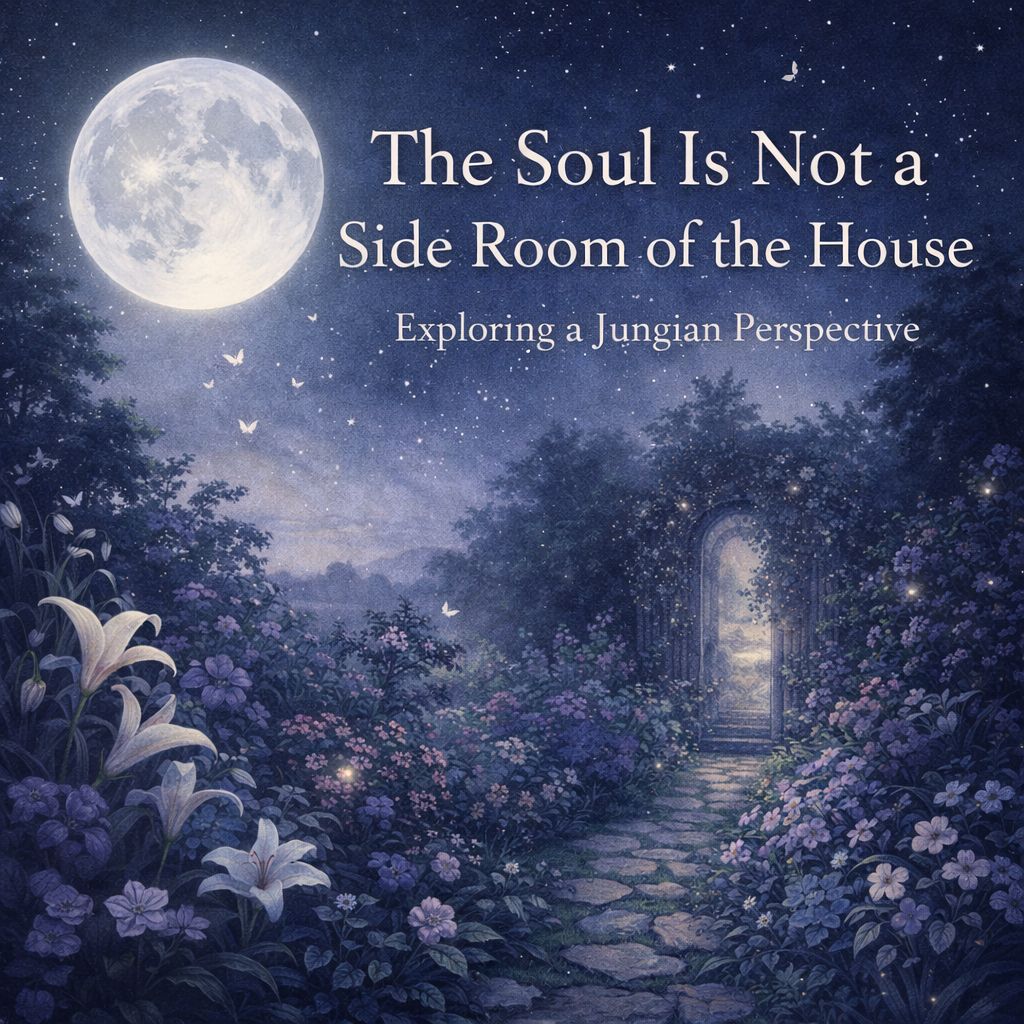
Jung is describing a culture that has learned to look outward with extraordinary precision — to measure, classify, engineer, and explain — while slowly forgetting how to look inward with reverence. In that forgetting, the soul becomes treated as decorative rather than essential. Something private. Something optional. Something vaguely embarrassing in the face of hard facts and public achievement.
And yet Jung is pointing to a paradox:
If the soul is treated as worthless, it does not disappear. It goes underground.
The Cost of Exterior Living
When meaning is located exclusively outside ourselves — in institutions, ideologies, productivity, or even in a distant conception of God — the interior world becomes undernourished. The psyche is still alive, still generating images, longings, fears, and symbols, but without conscious relationship it begins to express itself indirectly.
This is not a moral failure. It is a structural imbalance.
A life lived only outward tends to produce a strange hunger. We see it in the restless pursuit of validation, certainty, or distraction. We see it in the suspicion toward anything that cannot be quantified. We see it in the quiet anxiety that surfaces when external scaffolding fails.
Jung’s observation is not a rejection of the outer world. It is a reminder that outer mastery without inner cultivation is incomplete.
Putting Something Into the Soul
The phrase that lingers is this: people who put nothing into their souls.
What does it mean to put something into the soul?
It does not mean adopting beliefs for their own sake. It means participating consciously in the symbolic life that is already unfolding within us. It means allowing dreams, imagination, art, grief, wonder, and contradiction to have a place at the table of awareness.
To put something into the soul is to develop a relationship with interior experience that is marked by curiosity and reverence rather than dismissal.
This is the heart of Jung’s project. He insisted that the psyche is not a byproduct of life — it is one of its central dimensions. Religious language, mythic imagery, and archetypal patterns are not relics of a primitive past. They are expressions of structures that continue to shape human experience.
When we exile them, we do not become more rational. We become less whole.
Reverence as a Psychological Practice
Jung suggests that if much were in a person’s soul, they would speak of it with reverence. Reverence here is not submission. It is a quality of attention.
To approach the inner world reverently is to recognize that it contains depths we do not fully control. It asks for listening rather than domination. It invites dialogue rather than conquest.
This kind of reverence stabilizes a person in a way that purely external anchors cannot. It creates an inner axis — a center of gravity that allows us to engage the world without being consumed by it.
In this sense, Jung is not calling for retreat from modern life. He is calling for integration. A civilization that honors both outer knowledge and inner meaning is less likely to fragment under pressure.
A Culture in Conversation With Its Soul
Jung’s critique remains relevant because the tension he identified has not disappeared. If anything, the speed and saturation of contemporary life intensify the temptation to live entirely on the surface.
But his words are not pessimistic. They are invitational.
They ask each of us to consider what relationship we are cultivating with our own interiority. Not as an escape from reality, but as a dimension of reality that deserves attention. The soul is not a side room of the house. It is one of its foundations.
To neglect it is to live in a structure that feels increasingly hollow. To engage it is to rediscover a source of meaning that cannot be outsourced.
🔔 Invitation
Beloved reader, pause for a moment and notice what your inner world has been asking for lately. Not as a problem to solve, but as a conversation to enter. What images, feelings, or questions have been waiting patiently at the edge of awareness?
Sit with them gently. Listen without rushing to interpret. Even this small act is a way of putting something into the soul — a gesture of reverence toward the life unfolding within.
With devotion and wonder,
The Inspired Imaginative | The Devoted Mystic
© 2026 The Devoted Mystic.
All rights reserved. This content is the original work of the author and may not be copied or reproduced without explicit permission.

 thedevotedmystic.com
Leave a comment