There is a quiet assumption woven into a lot of spiritual language that growth and holiness live somewhere away from the personal self. That to become more spiritual is to become less individual — less particular, less human, less entangled in the textures of our own psyche.
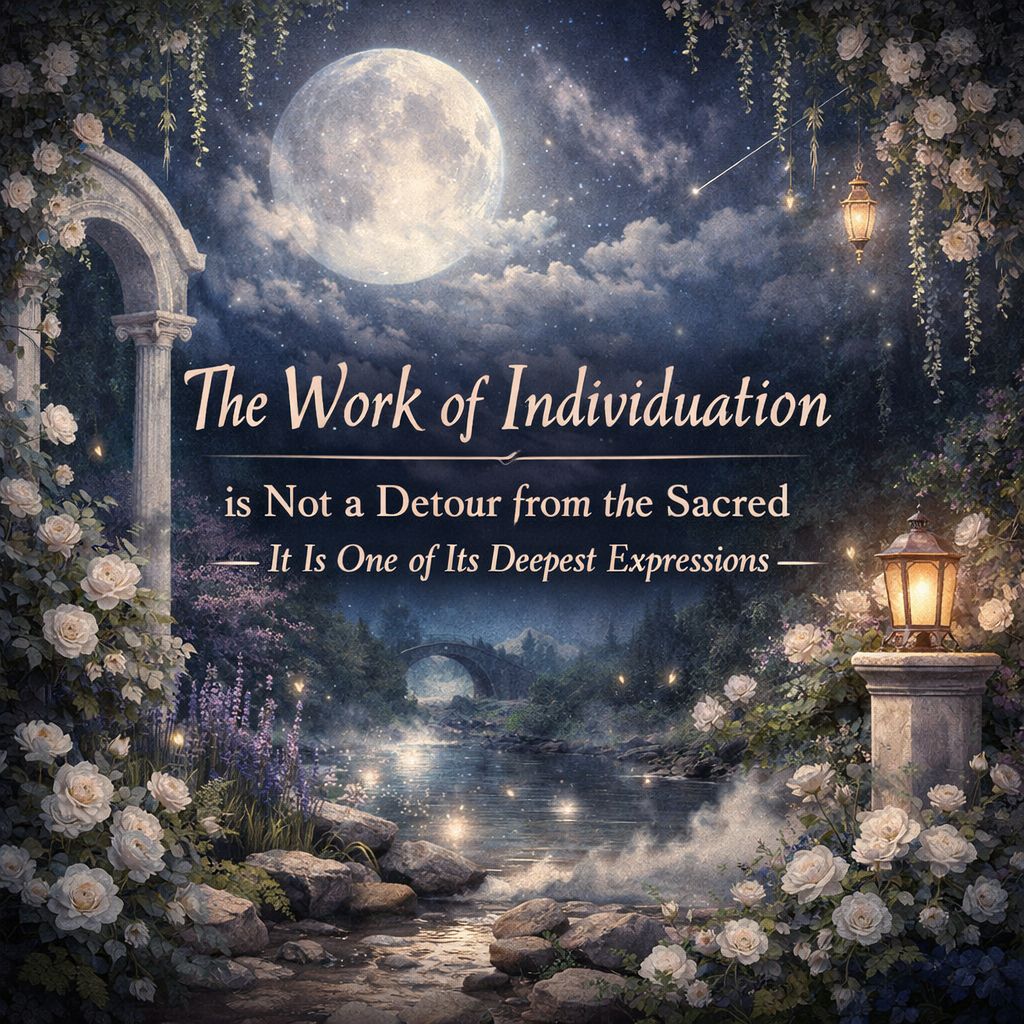
But the deeper I sit with the process Jung called individuation, the more it feels like the opposite is true.
Individuation is not self-absorption. It is not narcissistic navel-gazing or endless analysis for its own sake. It is the disciplined, often humbling work of becoming more whole. It is the slow gathering of the fragmented parts of a life — shadow and light, wound and gift, instinct and insight — into a more coherent center.
And when I look at that process through a spiritual lens, I don’t see a detour from the sacred. I see one of its most intimate expressions. 🌒
To individuate is to take seriously the fact that consciousness is not abstract. It lives in a body, in a history, in a psyche shaped by experience. The sacred does not hover above that terrain waiting for us to transcend it. It meets us inside it. Every time we face a disowned part of ourselves with honesty, every time we integrate a fear instead of projecting it outward, every time we claim a voice that was taught to stay silent, we are participating in a movement toward greater wholeness.
That movement is spiritual in the deepest sense.
Jung described the Self as the organizing center of the psyche — an inner image of totality that draws a person toward integration. When I read that, I hear an echo of older spiritual intuitions: that there is a deeper ground within us that is both personal and more-than-personal, a point where psyche and mystery touch.
Individuation is the path of aligning with that center. 🔥
It does not remove us from the world. It roots us more fully within it. A person who has done some of this work tends to become less reactive, less driven by unconscious patterns, and more capable of real relationship — with others, with the world, and with whatever name we give to the sacred. The work refines perception. It increases our capacity to hold paradox. It makes room for complexity without dissolving into chaos.
This is not separate from spiritual life. It is one of the ways spiritual life becomes embodied.
There is a temptation to imagine that the sacred is found only in peak experiences — visions, revelations, moments of transcendence. But much of the sacred work happens in quieter places: in therapy rooms and journals, in difficult conversations, in the courage to admit when we are wrong, in the patience to sit with unresolved tension. Individuation sanctifies the ordinary terrain of the psyche by treating it as worthy of attention and transformation.
It says: your inner life is not an obstacle to transcend; it is a field to cultivate. 🌙
When we honor that field, we are not turning away from the sacred. We are entering it through the doorway of our own humanity. The personal and the spiritual stop competing with each other and begin to cooperate. The psyche becomes not a prison to escape but an instrument through which deeper awareness can move.
From this perspective, individuation is a form of devotion. It is a commitment to truth over comfort, to integration over fragmentation, to becoming a person capable of carrying more consciousness in the world. And a world with more conscious people is a world where the sacred has more places to land.
The work is demanding. It asks for honesty, patience, and a willingness to encounter parts of ourselves we would rather avoid. But it also carries a quiet promise: that in becoming more fully ourselves, we do not move away from the sacred ground of existence. We move closer to it.
The path inward and the path toward the sacred are not two roads. They are one continuous movement — the unfolding of a life toward wholeness. ✨
🔔 Invitation
If this reflection meets you somewhere tender or familiar, I invite you to sit gently with your own inner landscape today. Notice one place where integration is asking for your attention — not to fix or force it, but simply to witness it with curiosity and compassion. The sacred is not waiting at the end of your becoming. It is already present in the work itself.
With devotion and wonder,
The Inspired Imaginative | The Devoted Mystic
© 2026 The Devoted Mystic.
All rights reserved. This content is the original work of the author and may not be copied or reproduced without explicit permission.

 thedevotedmystic.com
Leave a comment