There was a moment — quiet, almost ordinary — when I realized that understanding someone’s wounds did not make me responsible for carrying them. I was sitting with the familiar ache that follows an old pattern of over-explaining another person’s behavior, tracing their pain back through history as if compassion required me to dissolve inside it. And in that stillness, something in me shifted. I could see the forces moving through them clearly — and I could also feel the outline of my own life asking to be honored. That moment did not feel like hardness. It felt like mercy. Not mercy that erased truth, but mercy that allowed truth and self-respect to stand side by side.
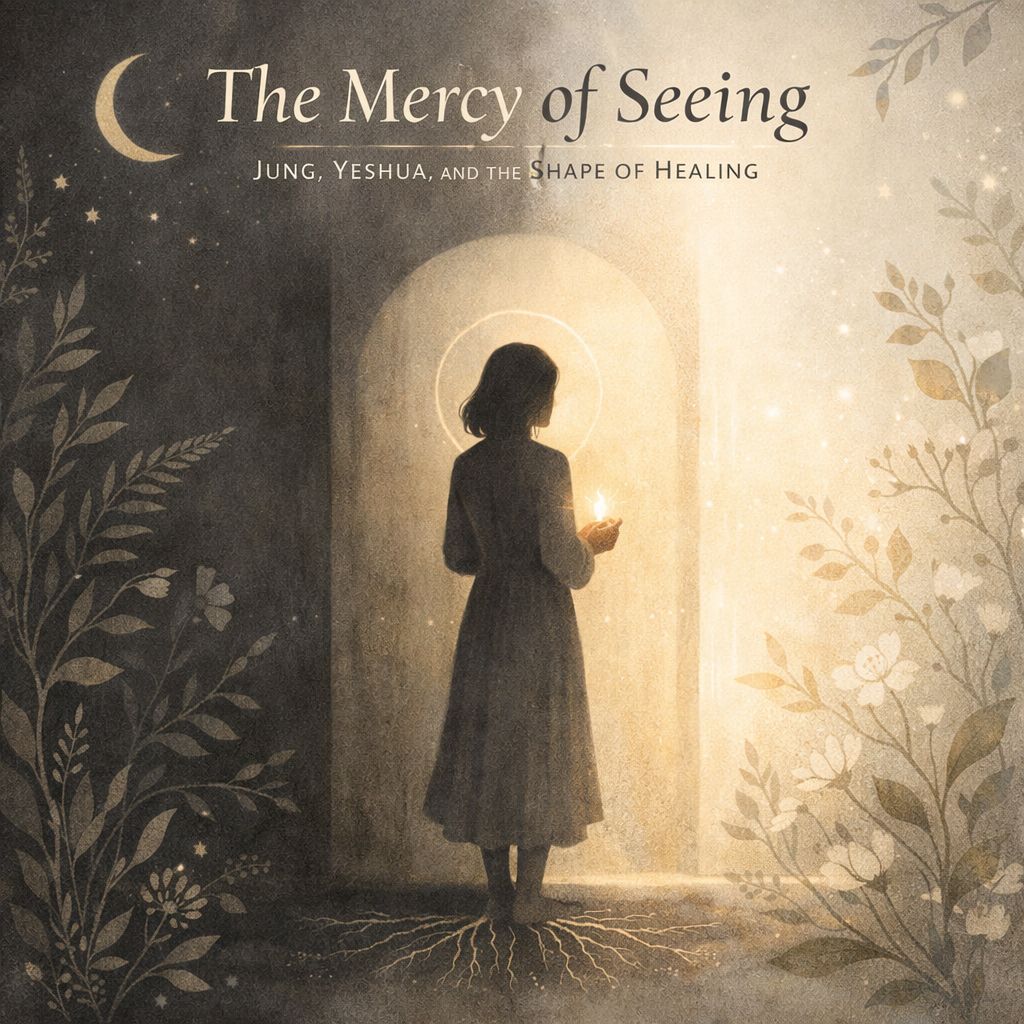
There is a kind of seeing that changes how a person walks in the world. It is not simply intellectual understanding or spiritual insight. It is the moment when awareness begins to carry ethical weight — when perception itself becomes a responsibility.
When I hold the insights of Carl Jung beside the example of Jesus Christ, what emerges is not abstract philosophy but a lived tension I recognize from surviving abuse. Jung speaks of the risk that comes with psychological sight — the mind’s tendency to step outside what it observes and quietly claim higher ground. In the landscape of abuse, that danger takes on intimate forms. I have felt the pull to disappear into another person’s wounds, to explain them so thoroughly that I erased my own pain. I have also felt the opposite pull: the urge to harden, to use clarity as distance.
Yeshua’s posture interrupts both extremes. His way of seeing exposes harm without enthroning condemnation. He refuses to collapse a person into their distortion, yet he never pretends the distortion is harmless. In that narrow space between exposure and exile, I recognize a model for how to remain human without surrendering myself. ✨
Mercy Is Not Self-Erasure 🌿
Living this out has taught me that the mercy of seeing is inseparable from boundaries. Jung’s insistence on humility reminds me that understanding the roots of another’s behavior does not obligate me to endure its impact. Awareness is not an invitation to self-sacrifice.
Yeshua’s relational presence shows that compassion can coexist with refusal — that one can acknowledge the suffering inside another without consenting to be shaped by it. In practice, this means allowing myself to see clearly and still step away when clarity reveals danger. It means holding the truth of what happened without turning that truth into a weapon, either against myself or against the other person.
This is where discernment becomes embodied. It stops being theory and becomes posture. It lives in the nervous system, in the way the body learns to remain open without remaining unprotected.
Where Awakening Becomes Livable 🔔
What both of their visions offer is a way to inhabit discernment as something steady and embodied. I can recognize unconscious forces at work without pretending I stand outside them. I can protect the integrity of my own life without denying the shared humanity between myself and those who hurt me. This is not forgiveness as forgetting, nor wisdom as detachment. It is a quieter discipline: remaining present to reality, setting limits where limits are needed, and letting understanding deepen compassion without dissolving self-respect. In that balance — clear sight joined to grounded mercy — awakening becomes something that can actually be lived.
Until Next Time,
The Inspired Imaginative | The Devoted Mystic
© 2026 The Devoted Mystic.
All rights reserved. This content is the original work of the author and may not be copied or reproduced without explicit permission.

 thedevotedmystic.com
Leave a comment