H. P. Lovecraft and the Fractured Human Psyche
There are writers we read for pleasure, and writers we read as mirrors—reflective surfaces that show us not who they were, but what consciousness itself was struggling to metabolize at a particular moment in history.
H. P. Lovecraft belongs to the second category.
I’m not interested in defending him.
I’m not interested in condemning him.
I’m interested in listening to what his work reveals—about the human psyche, about fear at the edge of knowledge, and about what happens when science dismantles the heavens faster than the soul can adapt.
This is not a claim about what Lovecraft meant.
It’s an exploration of what his work does.
The Shock of a Universe Without a Center
Lovecraft was writing in the aftermath of a profound psychic rupture.
By the early twentieth century, Western consciousness had lost its old anchors. Darwin had displaced humanity from the center of creation. Astronomy had expanded the universe beyond comprehension. Physics was unraveling certainty itself. Time stretched backward into abyssal depths. Space became cold, vast, and indifferent.
The old story—of a cosmos arranged for human meaning—no longer held.
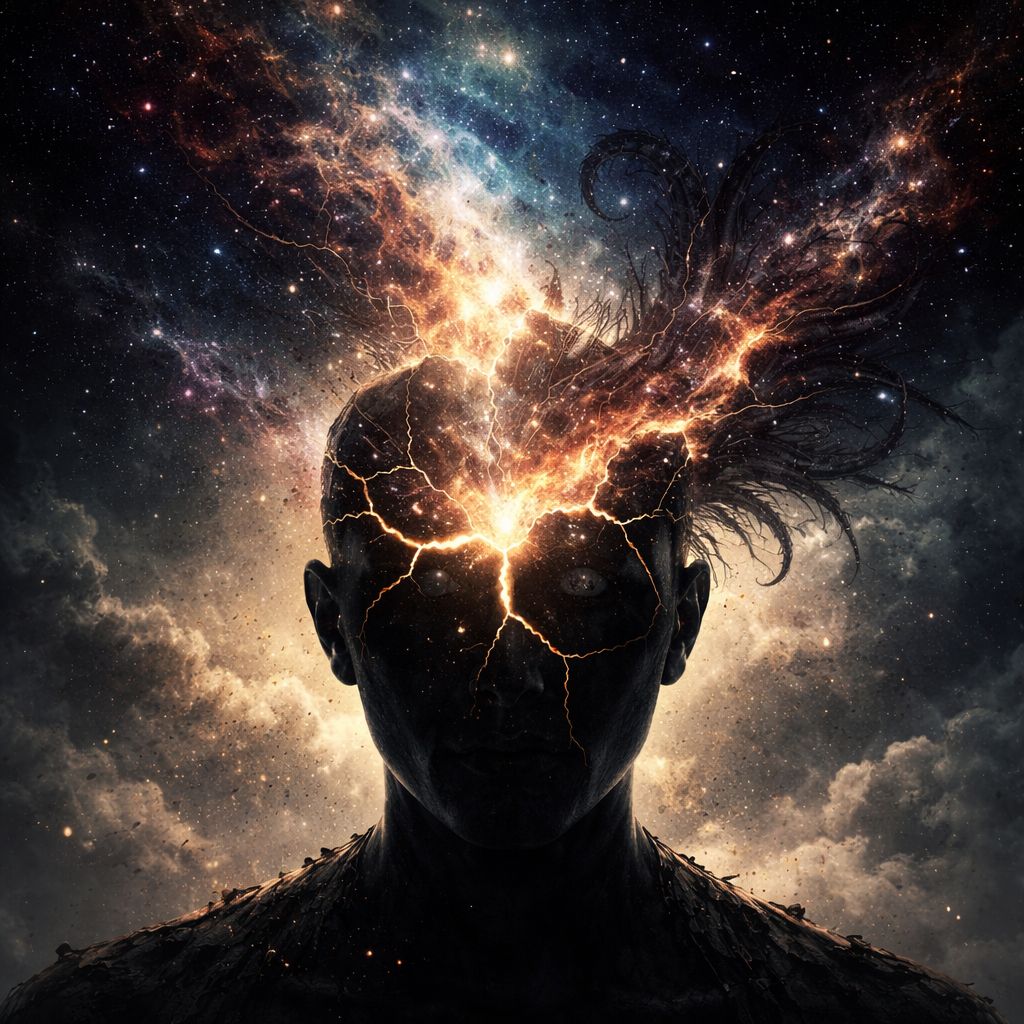
Lovecraft’s horror is often described as “cosmic,” but that word can obscure what’s really at stake. His stories are not frightening because monsters exist. They are frightening because meaning collapses. Because the universe no longer recognizes us as special. Because consciousness encounters something it cannot integrate.
In Jungian terms, this is the ego confronting the numinous without a symbolic container.
The True Horror Is Psychological
One of the most revealing features of Lovecraft’s work is not the creatures—but the narrators.
They stammer.
They fracture.
They lose language.
They descend into obsession, madness, or silence.
Again and again, perception itself becomes the breaking point.
Jung wrote that when unconscious material floods consciousness without mediation, the psyche destabilizes. Symbols are meant to translate the unknown into forms the soul can hold. Lovecraft’s narrators encounter knowledge without translation—raw, unbuffered, overwhelming.
The result is not enlightenment.
It is psychic disintegration.
What we are witnessing is not a moral failure, but a psychological one: consciousness expanding faster than the human vessel can adapt.
Science, Materialism, and the Return of the Gods
Lovecraft was an avowed materialist. He rejected religion, transcendence, and divine purpose. And yet—his fiction is crowded with gods.
Not loving gods.
Not moral gods.
But ancient, indifferent intelligences beyond human scale.
This paradox is telling.
When traditional myth collapses, the psyche does not become empty. It generates new figures. Jung observed that gods do not disappear; they go underground. They return disguised—as instincts, as obsessions, as projections, as cosmic horrors.
Lovecraft’s “Great Old Ones” function less as theology and more as psychic archetypes—personifications of a universe too vast for the ego to bear.
When God was dethroned by science, something else rushed in to fill the vacuum.
The Shadow of the “Other”
This is where the terrain becomes uncomfortable—and where honesty matters.
Lovecraft’s work is saturated with fear of the foreign, the unfamiliar, the non-Western. Places like the Caribbean, Africa, and imagined “degenerate” cultures appear not as lived realities, but as symbolic thresholds—edges of civilization where order dissolves.
It’s important to say this plainly: these depictions are not accurate portrayals of Cuban or Caribbean life or consciousness. They are projections.
Jung would call this the Shadow—those parts of the psyche disowned and externalized. Colonial anxiety, racialized fear, and cultural fragility were projected outward, onto the figure of the “Other.”
What Lovecraft feared was not these cultures themselves, but what they represented to Western consciousness: permeability, hybridity, continuity with ancient time, and the dissolution of rigid identity.
His horror reveals where the psyche draws its defensive lines.
A Literature of Thresholds
Read this way, Lovecraft becomes a chronicler of transition.
He stands at the threshold between:
- religion and science
- myth and materialism
- ego certainty and existential vertigo
His stories ask—without answering—what happens when the old gods are gone, and the new universe offers no comfort in return.
Jung believed that individuation requires integrating the unknown rather than being possessed by it. Lovecraft shows us what happens when that integration fails.
His work becomes a cautionary tale, not about monsters, but about what occurs when consciousness expands without heart, imagination, or symbolic grounding.
Reading Lovecraft Now
To read Lovecraft today is not to venerate him.
Nor is it to erase him.
It is to engage his work as a psychic artifact—a record of fear, projection, and awe during a time when humanity was realizing it might not be the center of anything at all.
Perhaps the deepest horror in Lovecraft’s universe is not cosmic indifference—but the absence of a relational bridge between human consciousness and the vastness it encounters.
And perhaps our task now is the one he could not imagine:
to hold the immensity of the cosmos
without losing our humanity
or projecting our terror onto one another.
🔔 Invitation
What stories are we telling now, at the edge of new thresholds—artificial intelligence, planetary collapse, expanding consciousness?
And what fears are we still externalizing instead of integrating?
Sit with that. Let it breathe. Let it trouble you gently.
With devotion and wonder,
The Inspired Imaginative | The Devoted Mystic
© 2026 The Devoted Mystic.
All rights reserved. This content is the original work of the author and may not be copied or reproduced without explicit permission.

 thedevotedmystic.com
Leave a comment