There is a principle so old it keeps reappearing under different names—mystical, psychological, philosophical—across cultures that never met and scriptures that never agreed.
Yet they are all pointing to the same mechanism.
🜂 What is not made conscious within us does not stay contained.
🜃 It moves outward.
🜄 It becomes fate, conflict, illness, projection, or history itself.
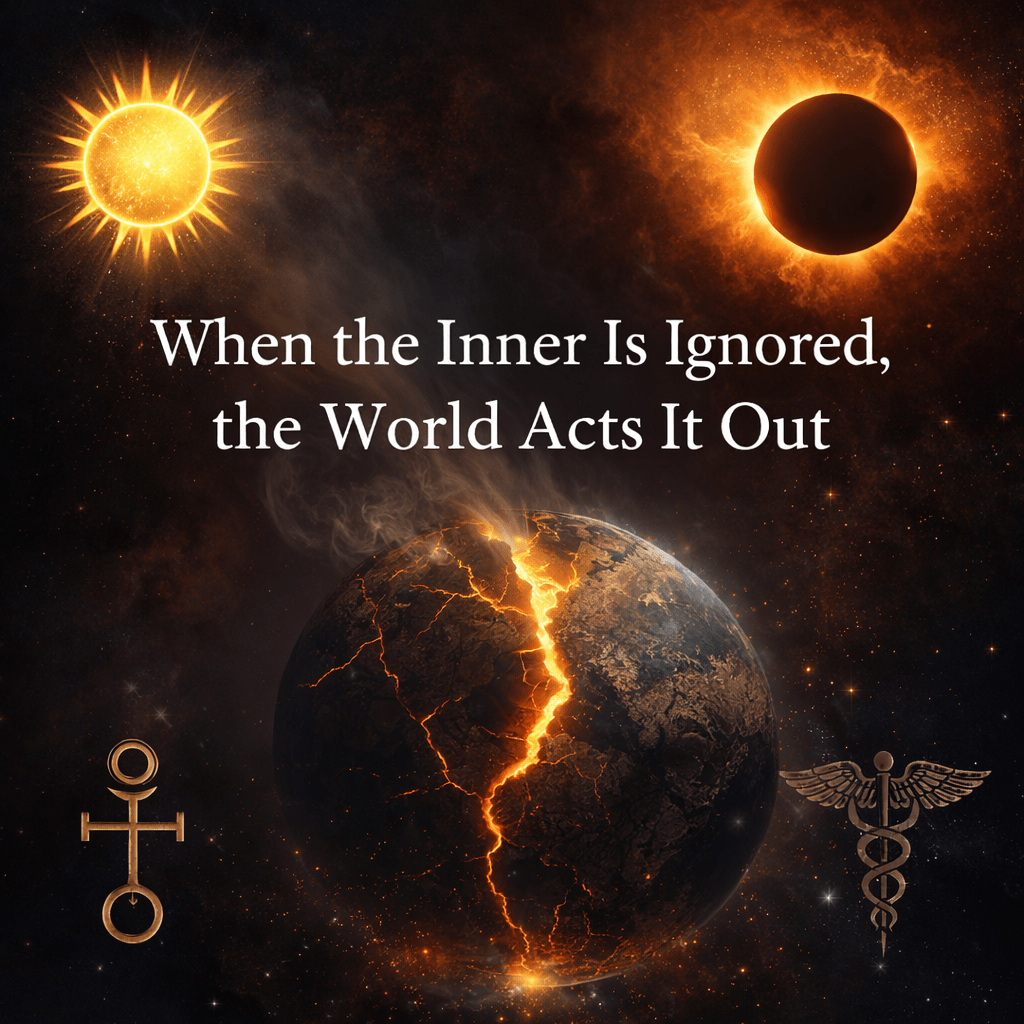
Carl Jung named it with stark clarity:
“The psychological rule says that when an inner situation is not made conscious, it happens outside, as fate.”
This is not a threat.
It is not a moral warning.
It is a description of how reality behaves.
🌑 The Inner World Is Not Optional
Long before modern psychology, this same truth was spoken in mystical language.
The Gospel of Thomas puts it bluntly:
“If you bring forth what is within you, what you bring forth will save you.
If you do not bring forth what is within you, what you do not bring forth will destroy you.”
This isn’t about salvation as reward or punishment.
It’s about expression versus repression.
✨ What is unlived does not disappear.
✨ It waits.
✨ And when it can no longer wait, it finds another stage.
🌒 As Within, So Without
Hermetic philosophy framed this law cosmically:
“That which is below is like that which is above, and that which is above is like that which is below, to accomplish the miracles of the One Thing.”
This is not metaphor in the poetic sense.
It is structural.
🜁 Inner fragmentation produces outer fragmentation.
🜁 Inner coherence produces outer coherence.
The world mirrors us—not morally, but mechanically.
🌘 Consciousness Is a Responsibility, Not a Belief
Buddhism does not call suffering a punishment.
It calls it a consequence of unseen mental formations.
The Dhammapada opens with this:
“All that we are is the result of what we have thought: it is founded on our thoughts, it is made up of our thoughts.”
Thought here does not mean opinion.
It means patterns of mind that have not been examined.
🧠 What we do not see clearly, we reenact.
🧠 What we do not integrate, we repeat.
🌗 When the Shadow Is Avoided, It Governs
Jung warned that when individuals refuse to confront their inner contradictions, the conflict does not resolve—it migrates.
It shows up as enemies.
As polarization.
As moral crusades.
As collective breakdown.
⚔️ The world becomes the battleground for what the psyche refused to hold.
This is why periods of mass instability are always accompanied by fundamentalism, apocalyptic thinking, and projection.
When inner work is avoided, the outer world is forced to perform it.
🌖 Repair Begins Inside
Jewish mysticism names this repair tikkun:
“When a person arouses himself below, an arousal is awakened above.”
This is not self-improvement.
It is participatory responsibility.
🌱 Inner integration contributes to collective repair—not symbolically, but structurally.
🌕 This Is Not About Blame
None of these traditions claim suffering is deserved.
They suggest it is informative.
What is happening “out there” is often the psyche asking—sometimes begging—to be seen.
🜄 The work is not to control the world.
🜄 The work is to stop abandoning the inner landscape.
🕯️ The Invitation
So the question isn’t “How do we fix the world?”
The question is quieter—and harder:
✨ What within me is asking to be seen before it needs to be acted out?
✨ What truth have I postponed until it could no longer remain internal?
✨ Where am I being invited into awareness—not perfection, just honesty?
Because every tradition we’ve touched here agrees on one thing:
🌑 The work we refuse inwardly will be demanded outwardly.
🌕 The work we choose inwardly changes the field we live inside.
And that choice—to see, to name, to integrate—
is where participation begins.
With devotion and wonder,
The Inspired Imaginative | The Devoted Mystic
© 2026 The Devoted Mystic.
All rights reserved. This content is the original work of the author and may not be copied or reproduced without explicit permission.

 thedevotedmystic.com
Leave a comment