Reading the Gospel of Thomas as an Initiation
There are texts you study…
and then there are texts that quietly begin studying you.
The Gospel of Thomas feels like the latter for me. Not a gospel in the sense of doctrine or belief, but a collection of mirrors — each saying less interested in telling you what to think and more interested in revealing where you’re still standing apart from yourself.
Lately, two sayings have been working me from the inside out. Not loudly. Not urgently. But persistently — like something ancient knocking from beneath the floorboards of awareness.
“Whoever discovers the interpretation of these sayings will not taste death.”
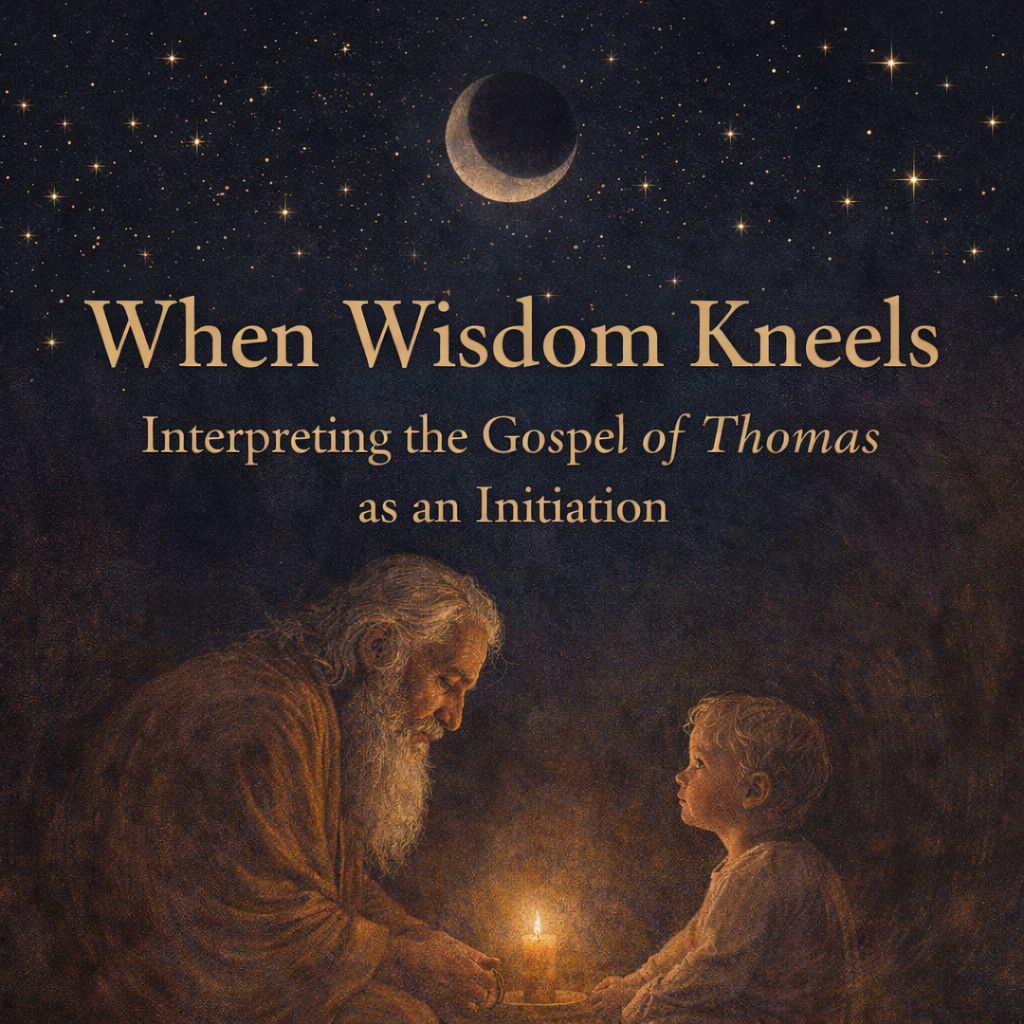
“The person old in days will not hesitate to ask a little child seven days old about the place of life…”
I don’t hear promises in these lines.
I hear thresholds.
🌑
Not Tasting Death (And Why This Isn’t About Dying)
At first glance, the words “will not taste death” can sound dramatic, even mystical in a way that invites misunderstanding. But the longer I sit with Thomas, the clearer it becomes that death here isn’t biological.
It’s existential.
It’s the death we taste when we live divided — when we mistake the mask for the face, the role for the soul, the story for the truth. The kind of death that feels like exile from one’s own center.
Thomas doesn’t offer salvation from death.
He points toward a way of realizing you’ve already been living as if separated — and invites you back.
The “interpretation” he speaks of isn’t intellectual. It isn’t something you arrive at through agreement or belief.
It’s the kind of knowing that happens when something inside you quietly says:
Oh. I recognize this.
🕯️
When the Elder Asks the Child
The second saying undoes hierarchy entirely.
The one “old in days” — the experienced self, the adapted self, the self that knows how to survive — turns and asks a child seven days old about the place of life.
Not a metaphor for ignorance.
A metaphor for original being.
Seven days: a complete cycle.
A child before identity, before shame, before performance.
This isn’t regression.
It’s return.
It suggests that real maturity isn’t about accumulating wisdom, but about becoming humble enough to let innocence speak again — not naivety, but essence.
And when that happens, Thomas says something quietly radical:
“The first will be last… and they will become a single one.”
The divided self dissolves.
The hierarchy collapses.
The inner elder kneels before the inner child — and life flows again.
🌿
Jung, Hermes, and the Same Old Door
Reading these sayings alongside psychology and myth only deepens their resonance.
Jung spoke often about individuation not as becoming “better,” but as becoming whole — a process where the ego eventually learns to listen to something older and wiser within.
Hermes, too, appears here — not as a teacher who hands out answers, but as a guide who leads us across inner thresholds. He doesn’t spare us from symbolic death; he teaches us how to cross it consciously.
And non-dual traditions echo the same truth in different language:
what we fear losing was never what we truly were.
Different vocabularies.
Same interior event.
✨
A Small Tarot Spread for Sitting With This
If you’d like to let this reflection move from thought into lived inquiry, here’s a simple three-card spread you can work with slowly:
🃏 Card 1 — The Mask I No Longer Need
What identity, role, or self-concept is ready to loosen its grip?
🃏 Card 2 — The Child Who Knows
What part of me carries unconditioned truth or original knowing?
🃏 Card 3 — Becoming the Single One
What integration is now possible if I allow these two parts to meet?
This isn’t a spread for prediction.
It’s a spread for recognition.
🌒
Closing Thoughts
What I love most about the Gospel of Thomas is that it refuses to rescue us. It doesn’t flatter the ego or offer certainty. It simply points — again and again — back toward the place where separation dissolves.
Not by ascent.
But by return.
Not by becoming more.
But by remembering.
Maybe that’s what it means to “not taste death” —
to stop living as if we were ever truly apart from life in the first place.
🕯️
With devotion and wonder,
The Inspired Imaginative | The Devoted Mystic
© 2026 The Devoted Mystic.
All rights reserved. This content is the original work of the author and may not be copied or reproduced without explicit permission.

 thedevotedmystic.com
Leave a comment