They say Orpheus descended for love, but perhaps it was for truth.
He carried no sword, no shield — only the trembling instrument of his soul. While others begged the gods for favor, he dared to charm them into stillness. Even Hades, the unmoved one, bowed to the current of a mortal voice that remembered where it came from.
Yet Orpheus was never merely a lover mourning loss. He was a revolutionary disguised as a musician — one who refused to accept the finality of death as law. To sing at the threshold is to challenge the order of the cosmos. To turn back is to remember what the divine tried to make us forget: that we, too, can call the dead by name.
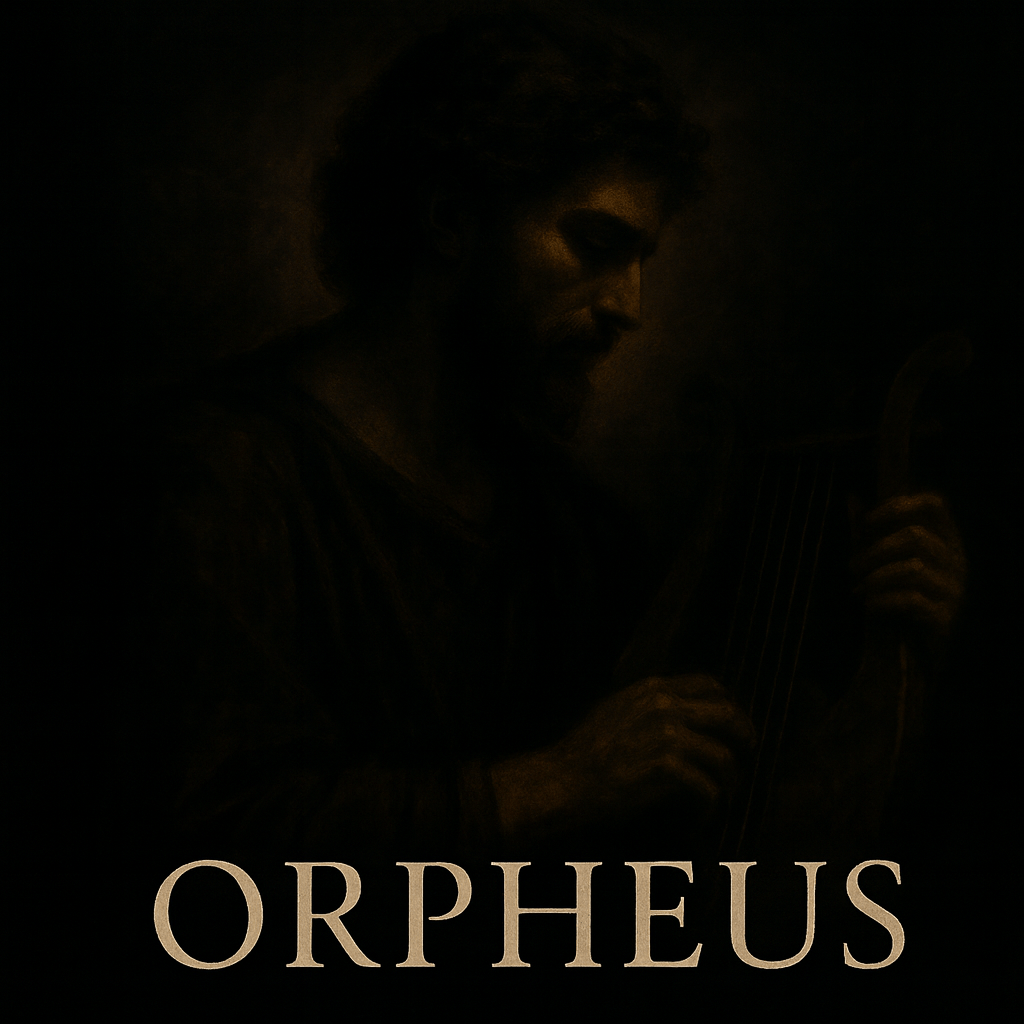
🔥 The Myth as Mirror — Jungian Reflection
Jung would call this the peril of the artist-psyche — the anima’s descent into shadow to reclaim what life rejected. Eurydice becomes the lost instinct, the feeling nature buried beneath intellect and form.
Orpheus, entranced by his own light, mistakes the echo for the song itself. His turning back isn’t failure; it’s the revelation that the soul’s work can’t be completed in a single realm.
Rebellion here is not defiance of the gods, but of illusion.
Remembrance is not nostalgia, but gnosis — the sacred act of seeing through veils.
In psychological terms, Orpheus symbolizes active imagination — the human capacity to make art of our underworlds. But remembrance demands a price: the artist who brings shadow to light must surrender attachment to how it appears. The moment he clings to form (Eurydice’s face, beauty, belonging), it dissolves. Only the essence remains — the song itself.
🌕 Ritual Thread — The Song You Cannot Forget
Tonight, light a single candle and hum softly to the flame.
Think of one part of yourself or your past that still calls from the dark — not as pain, but as a melody unfinished. Write one line, one phrase, or one hum that belongs to that part of you. Sing it. Whisper it. Remember it.
Then, without recording or writing it again, let it go.
Your soul remembers what your mind cannot.
This is how Orpheus teaches rebellion:
not by holding on, but by daring to sing even as everything you love dissolves into mist.
💫 Closing Reflection
Rebellion, when rooted in love, becomes remembrance.
Remembrance, when sung aloud, becomes resurrection.
And resurrection, when freed from outcome, becomes art.
Orpheus did not fail.
He fulfilled the first law of creation:
to turn back toward what we lost — and in doing so, awaken what was never truly gone.
🔔 Invitation
Beloved seeker, may this Lantern guide you not with blinding light, but with the soft shimmer of faith reborn. Sit with your vessel, pour gently, and remember: even in silence, the stars are still speaking.
With devotion and wonder,
The Inspired Imaginative | The Devoted Mystic
© 2025 The Devoted Mystic.
All rights reserved. This content is the original work of the author and may not be copied or reproduced without explicit permission.

 thedevotedmystic.com
Leave a comment