🌌 East Meets Depth
When Richard Wilhelm first laid eyes on the I Ching in China, he did not see an exotic puzzle or a foreign curiosity. He saw a living oracle — a voice as ancient as the mountains, whispering through the hexagrams of change. When he translated those whispers into German, he carried across more than words: he carried across the soul of a tradition.
And it was Carl Jung who heard that voice resound in the West. He recognized that these hexagrams were not strange signs, but familiar archetypes — the very patterns that surfaced in his patients’ dreams, in alchemical images, in the mandalas they drew during individuation.

🕯️ Archetypes in the Hexagrams
The I Ching speaks in symbols. So does the psyche. What Wilhelm preserved in his translations allowed Jung to glimpse the universality of these patterns:
- The Self — Hexagram 1 (Ch’ien, The Creative) and Hexagram 2 (K’un, The Receptive): heaven and earth, yin and yang, the mandala of wholeness.
- The Shadow — Hexagram 36 (Ming I, Darkening of the Light): the hidden flame that must be faced in the darkness.
- Anima/Animus — Hexagram 31 (Hsien, Influence): the magnetic pull of relationship, the inner guide of attraction.
- The Wise Guide — Hexagram 27 (I, Nourishment): wisdom as the food of the soul.
- The Hero — Hexagram 46 (Shêng, Pushing Upward): the striving ego, growing steadily toward light.
- The Trickster — Hexagram 4 (Meng, Youthful Folly): the folly that humbles, the laughter that teaches.
- Death & Rebirth — Hexagram 49 (Ko, Revolution): the phoenix moment, the shedding of skin.
- The Child — Hexagram 24 (Fu, Return): innocence, renewal, the eternal turning back toward beginning.
These are not foreign archetypes — they are mirrors. The I Ching gives them new names, new stories, new hexagonal bones, but the spirit within them is the same pattern Jung called the collective unconscious.
🌿 Synchronicity as Oracle
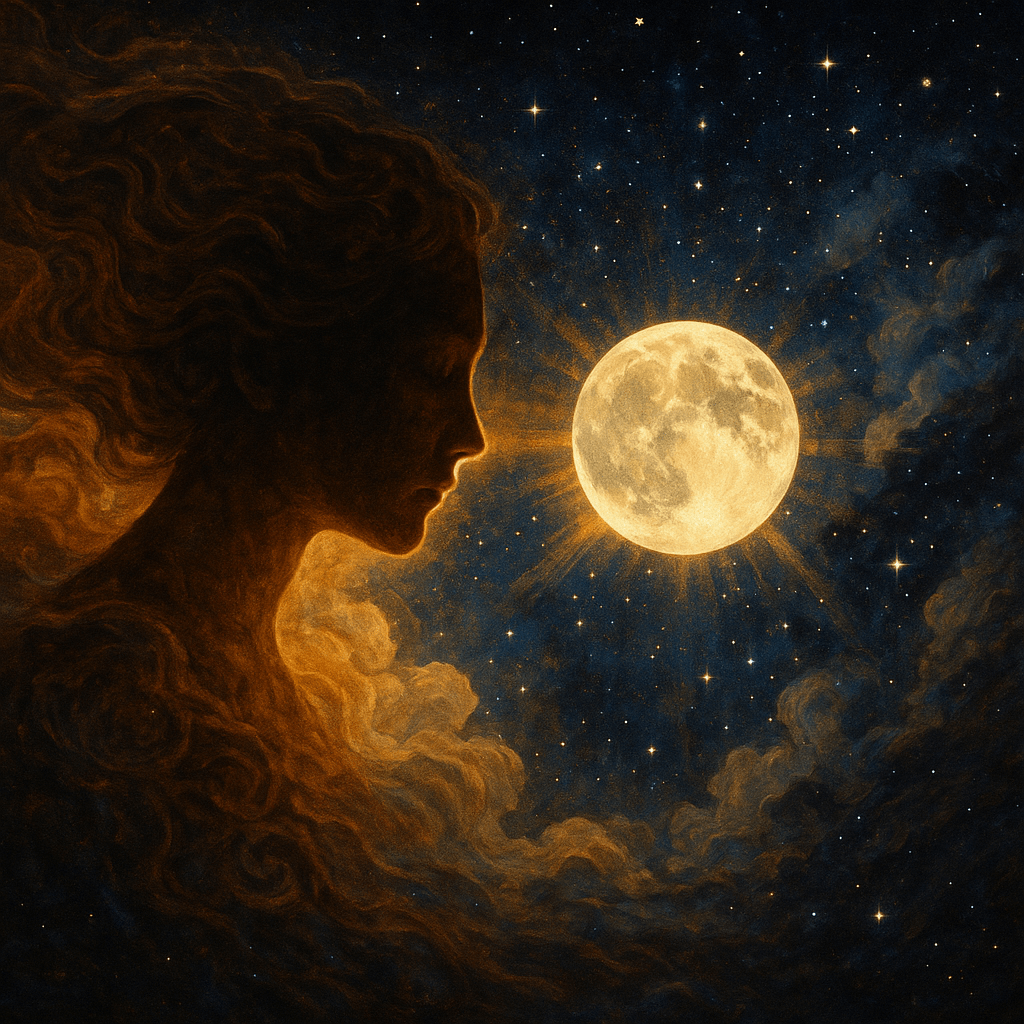
Jung’s great insight was that consulting the I Ching is not about predicting the future. It is about the meaningful coincidence between psyche and cosmos. The moment you cast your coins or stalks, you are synchronizing with the archetype that lives in you and in the world.
The oracle becomes a mirror, not of what will happen, but of what is already unfolding in the soul. Jung saw in this a profound ally to psychology: a way of listening to the unconscious through the ritual of chance.
✨ The Bridge We Walk
Wilhelm was the translator. Jung was the interpreter. And we — modern mystics, seekers, dreamers — are the inheritors of that bridge.
Each hexagram, each archetype, is a lantern lit across the ages. When we consult the I Ching and dream with Jung, we are not practicing two different traditions, but one universal dialogue with the unconscious.
This is what the East and West remind us: symbols are not bound by borders. They are the language of soul itself.
🔮 An Invitation
The next time you engage in divination, or if it is your first time, I encourage you to ask: Which archetype is greeting me now?
Instead of asking, “What will happen next?”
- Draw the hexagram, tarot, or recall a synchronicity
- Listen for the Jungian echo in your dreams.
- Sketch a mandala or symbol that carries the pattern into your own imagination.
In this way, you walk the same bridge Wilhelm and Jung built: an oracular dialogue between psyche and cosmos, Self and Tao.
And remember, “In every hexagram and every dream, the soul remembers its universal tongue.”
Until Next Time,
The Inspired Imaginative | The Devoted Mystic
© 2025 The Devoted Mystic.
All rights reserved. This content is the original work of the author and may not be copied or reproduced without explicit permission.

 thedevotedmystic.com
Leave a comment