A Mirror of Madness, Meaning, and the Myth of the Single Self
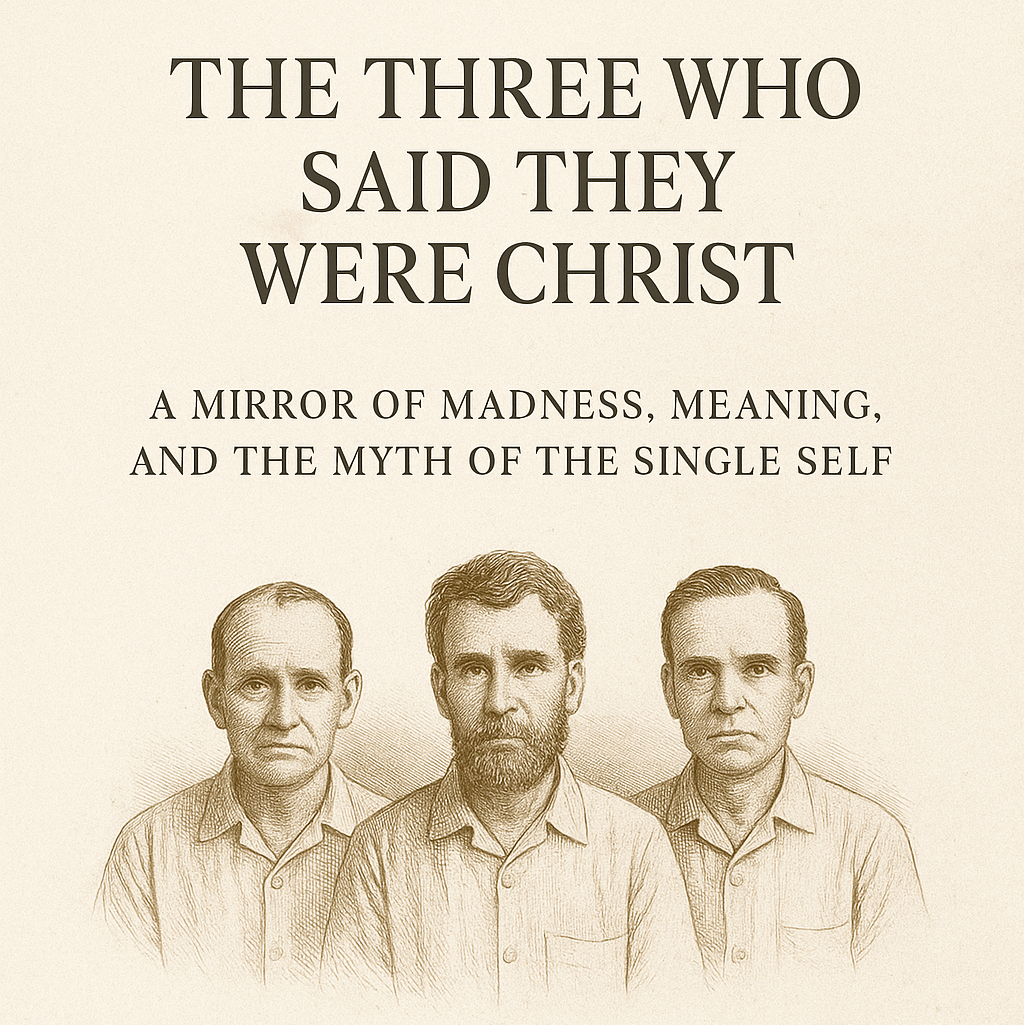
In 1959, three men were brought together at Ypsilanti State Hospital in Michigan. Each of them—Clyde, Joseph, and Leon—believed they were Jesus Christ. Clinical psychologist Milton Rokeach devised this unorthodox experiment to see what would happen if their delusions were forced into direct confrontation with each other. Would one recant? Would their belief structures collapse under the weight of mirrored contradiction?

They did not.
Instead, the three men restructured their realities to accommodate each other’s presence. They rationalized. One man declared the others were dead. Another insisted they were patients, not divine. Each held to his narrative like a raft in turbulent waters.
And Rokeach? He played God in a different way—writing fake letters from imaginary figures, manipulating interactions, even fabricating messages from “God” to provoke a break in the illusion.
He got no such break.
But something else broke.
Years later, Rokeach would write:
“I had no right, even in the name of science, to play God and interfere with their lives.”
🌀 The Jungian Lens: Who Speaks Within?
From a Jungian perspective, the entire experiment reads less like a clinical study and more like a dream emerging from the collective unconscious. Each man, in his suffering and delusion, carried an aspect of the archetypal Self—that central organizing principle of wholeness, often personified by the divine or messianic figure. When three men claim to be Christ, we are not simply witnessing pathology. We are being asked to consider:
- What is the true cost of fractured identity in a fragmented world?
- How does the Self assert itself when the ego is splintered or overthrown?
- What happens when the god-image is projected outward—onto the therapist, the institution, or even the self—without integration?
In Jung’s language, this is the peril of inflation—when the ego is overwhelmed by unconscious contents and identifies with an archetype rather than relating to it. In these men, the Christ archetype was not symbolically held or integrated. It possessed them. And instead of being met with reverent understanding, they were made subjects in a manufactured theology of control.
🪞 Reflections on the Mirror
The tragedy is not that these men believed themselves to be Christ.
The tragedy is that no one asked: Why did this image arise in you? What does it want to say?
What if, instead of trying to break their belief, someone had listened for the myth beneath the madness? What if the men were not simply sick—but speaking the soul’s language in metaphor, desperately trying to restore inner coherence?
From the Jungian lens, the Self appears when the psyche is attempting to heal—even if it arrives in disturbing, distorted forms. Whether as Jesus, a celestial guide, or a divine voice, the archetypal Self attempts to restore meaning where egoic structures have failed. But the modern mind has forgotten how to listen in symbol.
🕊️ A Note of Compassion (and a Warning)
In watching the 2017 film adaptation, Three Christs, I noticed the insertion of a suicide that never occurred in the real-life case. This fictional flourish may have aimed to underscore the emotional toll of the experiment, but in doing so, it rewrote the reality of these men’s lives.
This reminds me of something vital in all healing work—projection is power. To place our stories onto others, especially those whose sense of self is already fragile, is not harmless. It shapes worlds. Whether through experimental manipulation or cinematic license, there is a profound responsibility that comes with narrative authority.
✨ An Invitation
What parts of ourselves still believe we must be Christ—perfect, sacrificial, misunderstood?
What fragments within us argue over who is “real” and who is “delusional”?
Where might we be projecting our own unmet Selfhood onto those around us?
And most importantly:
What myth is arising in you now—not to be disproved, but to be heard?
🔮 Ritual Nudge
Create a sacred mirror altar. Sit with a candle, a mirror, and a journal.
Ask: “Who am I when all roles fall away?”
Write not as an answer, but as a prayer. Not to dissolve the delusion, but to dissolve the disconnection.
You are not here to prove your divinity.
You are here to integrate your wholeness—including the parts that forget, fragment, and fall apart.
Until next time,
The Inspired Imaginative | The Devoted Mystic
© 2025 The Devoted Mystic.
All rights reserved. This content is the original work of the author and may not be copied or reproduced without explicit permission.

 thedevotedmystic.com
Leave a comment