“Astrology represents the summation of all the psychological knowledge of antiquity.” — Carl G. Jung
There’s a sacred mirror between the stars and the self. Not one of fate, but of reflection—of archetype, rhythm, and psyche. For many, astrology is simply horoscopes and personality quizzes. But for the mystic, the seeker, and the psychologically-minded, it is a symbolic language echoing the same truths unearthed by depth psychology.
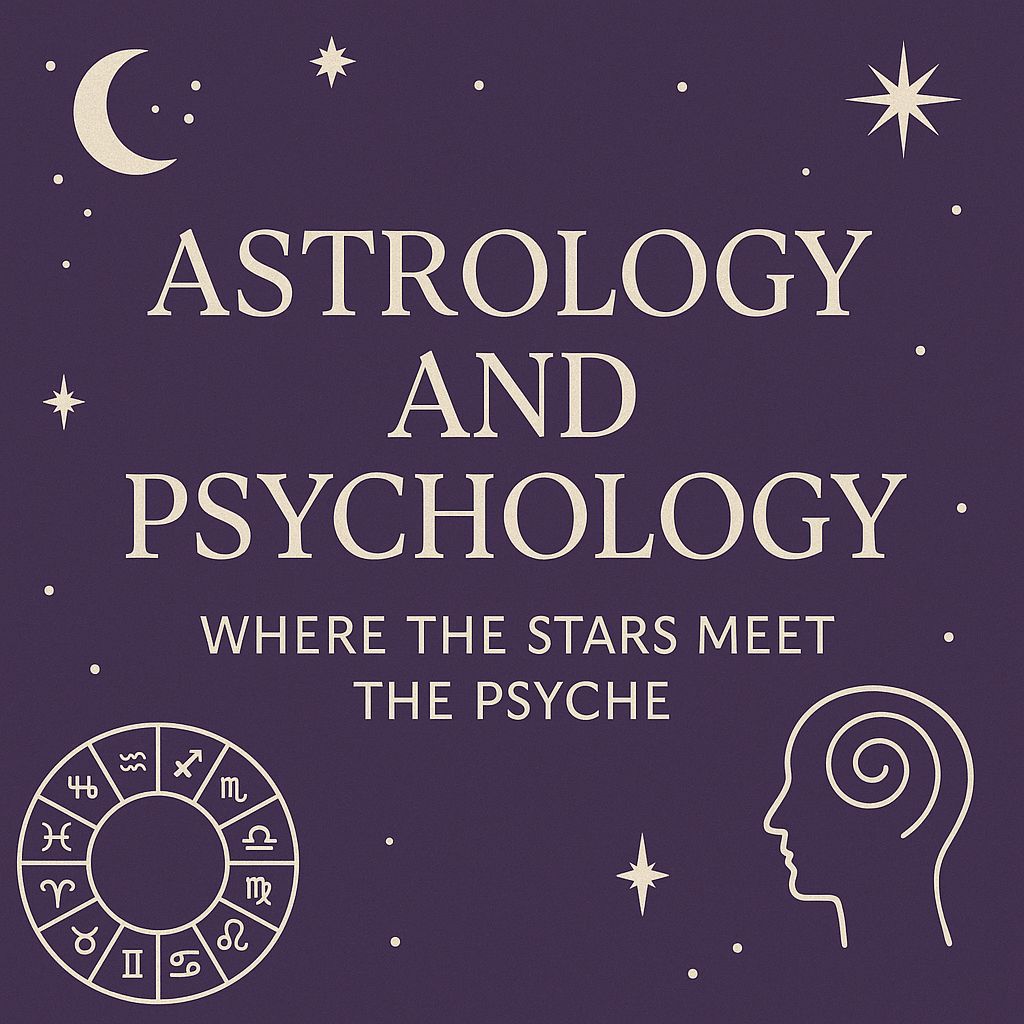
Carl Jung, the father of analytical psychology, found astrology to be a rich symbolic system that paralleled his own insights into the unconscious. In fact, he integrated astrological principles into his therapeutic work, often casting his patients’ charts to better understand the archetypal forces shaping their lives. Where modern psychology seeks patterns in behavior and myth, astrology maps those same patterns across time and sky.
The Birth Chart as a Psyche Map
In Jungian psychology, the psyche is composed of the conscious self, the personal unconscious, and the collective unconscious—the vast reservoir of inherited archetypes. Likewise, a natal chart contains symbols (planets), patterns (aspects), and houses (domains of life) that, when read archetypally, speak to the soul’s journey.
- The Moon reflects emotional instincts and inherited security patterns, much like the inner child or mother complex.
- Pluto symbolizes the death/rebirth process of the unconscious, the descent into shadow.
- Saturn holds the structure of the ego, the superego, the father archetype, and karmic lessons.
- Mercury operates as the Psychopomp—a Hermes figure mediating between conscious and unconscious realms.
Each planet, each house, each aspect acts as a symbolic shorthand for psychological dynamics we live out—often unconsciously. And like a dream, astrology doesn’t tell us what will happen. It invites us into relationship with what’s already happening within us.
Astrology as a Symbolic Mirror, Not a Script
Psychology helps us find language for our inner terrain. Astrology gives us timing and rhythm. Together, they become a compass for soul work.
Jung wrote of synchronicity, the meaningful coincidence between inner events and outer experiences. Astrology, at its essence, is synchronicity mapped—where the movement of the heavens reflects movements within. The chart doesn’t predict in a deterministic sense; it illuminates where we are in our becoming.
Healing Through Archetypal Awareness
Understanding your natal chart through a psychological lens can be healing in and of itself. You are no longer at the mercy of “bad luck” or “being too much.” You are a complex, evolving soul moving through patterned invitations—ancestral, personal, and transpersonal.
Where therapy may guide you through trauma, astrology can help you see when and why these archetypal gates are opening. The transits don’t cause the pain—they mark the moment the soul says, “Now. Now I’m ready to face this.”
And through that lens, nothing is wasted. Not even the wound.
You can create your own birth cart here, here or here, based on your preference… if you don’t already have one. I use the Porphyry system, based in Evolutionary Astrology.
Journal Prompts for Inner Stargazing:
- Which astrological placement in your chart feels most psychologically charged or alive right now?
- Where do you notice repetition in your inner world (thoughts, feelings, reactions) that aligns with a planetary archetype (Saturn, Pluto, Uranus, etc.)?
- If you could speak to your birth chart as a wise inner guide, what question would you ask?
Closing Thoughts
Astrology and psychology aren’t separate pursuits—they are reflections of the same yearning to understand who we are, why we suffer, and how we transform. When used together, they become a sacred dialogue between the cosmos and the unconscious, offering insight not as escape—but as a map back home.
Until Next Time, 🜁🜂🜃🜄
The Inspired Imaginative | The Devoted Mystic
© 2025 The Devoted Mystic.
All rights reserved. This content is the original work of the author and may not be copied or reproduced without explicit permission.

 thedevotedmystic.com
Leave a comment