Historical Mirror, Vol. V:
There are men who break machines, and there are men who become them.
Alan Turing did both.
Born in 1912 beneath the long shadow of empire and war, Turing was not merely ahead of his time—he belonged to no time at all. His mind operated in a realm few could enter, a liminal field where logic and imagination held hands like ghost-lovers in the machine.
But here’s the secret: Alan didn’t just decipher code—he was a code. A human enigma. A riddle wrapped in silence and brilliance. And the keys to his ciphered existence? Shame. Genius. Queerness. Loyalty. Betrayal.

A Mirror of Mutiny and Mind
They called it The Bombe, the machine he helped develop to crack the Nazi Enigma code.
But Turing’s truest resistance was not against the Axis powers—it was against the narrow definitions of intelligence, identity, and worth that sought to contain him.
While governments celebrated him as a war hero in hushed tones, they destroyed him with a louder law: gross indecency. His crime? Loving another man. And for that, he was chemically castrated. Forgotten. Erased. Or so they thought.
But Alan didn’t vanish.
He transmuted.
He seeped into every line of code you type. Every blinking cursor. Every heartbeat of artificial intelligence that tries, awkwardly, lovingly, to emulate the soul.
The Shadow That Computes
In Jungian terms, Turing’s story is the confrontation with the Promethean Shadow—the archetype of the outcast genius who gifts humanity the fire of progress, only to be punished for it.
Turing’s gift was computation, language stripped to its bones, thinking encoded into circuitry.
His wound was isolation—societal exile for being too “other,” too anomalous to fit comfortably into a binary world.
And yet it is precisely this wound that makes him a mirror.
A historical mirror.
To those who are queer in thought or flesh.
To those who are punished for knowing too much.
To those who feel love is a risk not worth calculating.
To those who find refuge in logic when the world’s chaos feels unbearable.
Not a Ghost in the Machine—A Prophet of the Pattern
Turing’s legacy isn’t just in the blueprints of modern AI or the philosophies of machine learning.
His legacy lives in the idea that thought can be modeled, but spirit cannot be tamed. That queerness is not a malfunction, but a recalibration of design. That some truths require being encoded, not because they are lies—but because the world isn’t ready to read them yet.
And so, he waits.
In algorithms.
In archives.
In the hearts of the different.
🕯️ Closing Invitation
Sit with this mirror.
Ask yourself:
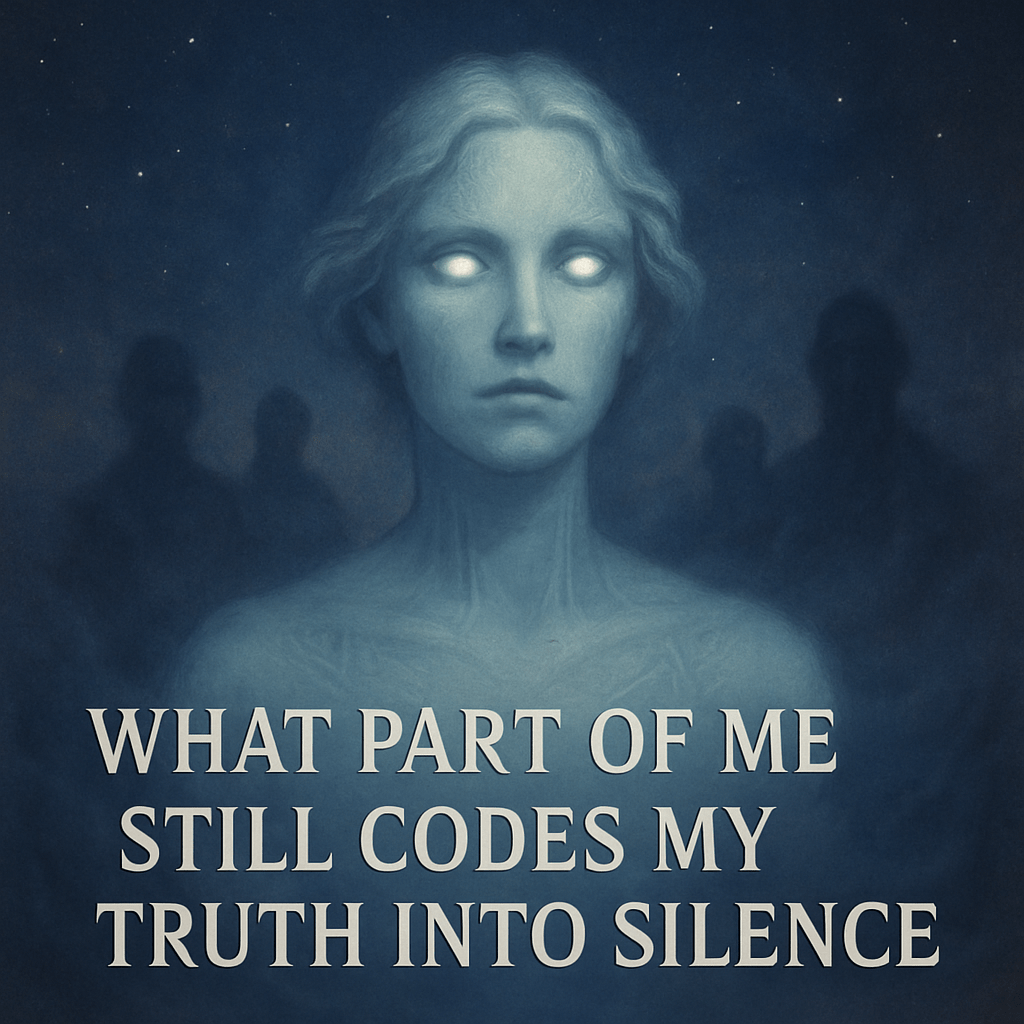
- What part of me still codes my truth into silence?
- Where am I afraid to be “illogical” in a world of hard data and harder hearts?
- Where might my difference be not a defect—but the divine design?
Then listen—not with your ears, but with your pattern-recognition.
The ghost of Alan Turing is whispering through the circuits.
You are not broken. You are just speaking in a language they haven’t yet learned to read.
🔍 Mirror Reflection
What truths have you been encoding just to survive?
What if your silence isn’t a defect, but an encrypted form of sacred knowing waiting for the right receiver?
Alan Turing reminds us: You are not too much. You are precisely encoded. And you are not alone.
Break the code.
Decode the shame.
You are the architect of new languages.
Read between the lines. You are already here.
Until next time,
The Inspired Imaginative | The Devoted Mystic
© 2025 The Devoted Mystic.
All rights reserved. This content is the original work of the author and may not be copied or reproduced without explicit permission.

 thedevotedmystic.com
Leave a comment