Historical Mirrors, Vol. III: The Philosopher-Priestess | The Silenced Mind
🕯There are women who are not just remembered—they are resurrected in the marrow of those who were born to remember them.

Hypatia is one of mine.
Not because I knew her history, but because I heard the way her name ached in the back of my throat when I first spoke it aloud.
Because I, too, have tasted what it means to be unread by the world you refuse to bow to.
Because I, too, was once told the fire in my mind made me dangerous.
Because I, too, have seen what happens when knowledge becomes a wound.
And still—I keep writing.
🔮 Hypatia’s Mirror
She taught in the last light of a dying library.
Not metaphorically—the literal Library of Alexandria, or what fragments remained of it, as Christian imperialism rose like a tide to drown the ancient world’s pagan brilliance. Hypatia, a philosopher, astronomer, mathematician, teacher, and priestess of Neoplatonic thought, was the last known head of the great school of Alexandria. She was revered for her mind, respected by students of all traditions, and unapologetically sovereign in a time when sovereignty in a woman was viewed as a heresy in itself.
She rode through Alexandria in her scholar’s robes, not as spectacle—but as signal. She was the threshold.
Her very presence broke boundaries: between philosophy and spirituality, between feminine wisdom and masculine fear, between the pursuit of truth and the politics of power. And so, the church—feeling threatened by her influence, her refusal to convert, and her audacity to teach men—tore her apart.
Literally.
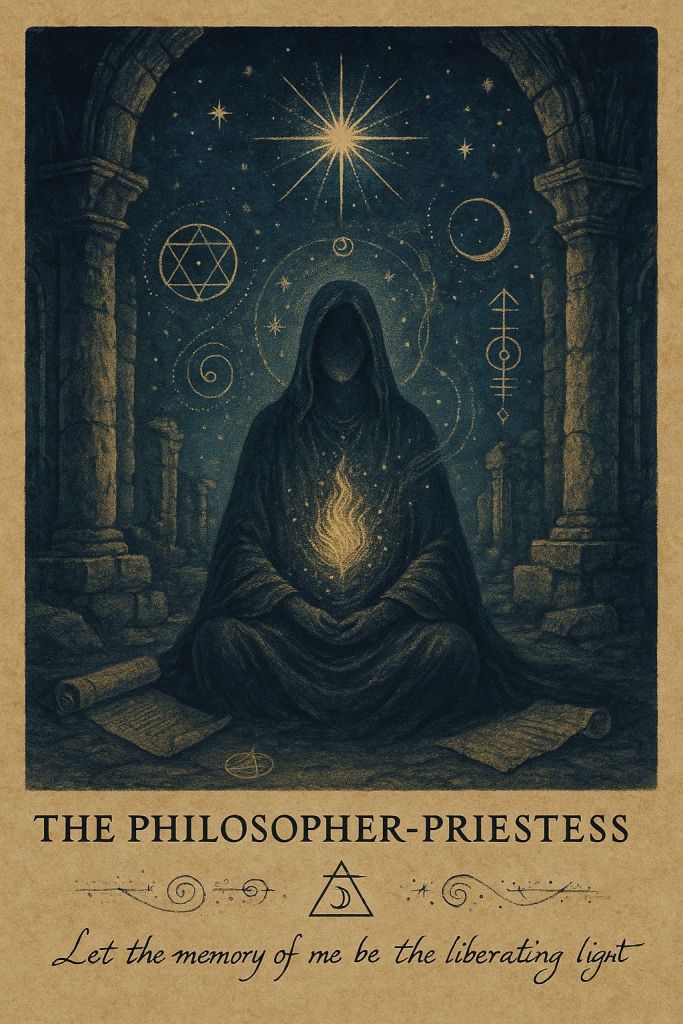
According to Socrates’ Ecclesiastical History (Book VII, Chapter 15) she was seized, by a group of zealots and dragged through the streets, stripped naked, flayed alive with ostraca (shards of pottery), and burned her remains.
This was not just murder. This was erasure.
The dismemberment of a living library.
But here’s the paradox empire always forgets:
You can burn the scrolls.
You can kill the scribe.
But the soul of a sacred truth-teller survives.
Not in pages—but in people.
🔥 The Ashes of Alexandria
What died with Hypatia was not logic. It was legacy.
A legacy of women who had once been initiates, not heretics.
A legacy where science was song, astronomy was divination, and mathematics mapped the music of the stars.
What rose from the ashes, though, was the myth of Hypatia.
And in that myth, she becomes more than philosopher—she becomes a symbol for every woman who has been silenced mid-sentence. Every teacher whose truth was unwelcome. Every mystic whose voice was mistaken for madness.
She lives now in the sacred disobedience of those who will not let the mind be severed from the soul.
🪞 Mirror Invitation
Where has your knowledge been punished?
Where were you told that your mind was too much, your questions too loud, your vision too strange?
And what part of your truth still waits to be taught, even if no one grants you a classroom?
You do not need permission to remember.
You do not need a podium to be a philosopher.
You do not need safety to become flame.
You need only the courage to keep thinking, keep questioning, and keep lighting candles in the libraries of your lineage.
Let Hypatia walk beside you the next time you write what scares you.
Let her whisper through the pages you’ve been too afraid to open.
She was not the last.
She was the threshold.

 thedevotedmystic.com
Leave a comment